Ingredient Science
Vitamin D and Hair Loss: Why Deficiency Matters
Vitamin D deficiency is one of the most common, most overlooked, and most fixable contributors to hair thinning. Here is how to spot it, test for it, and correct it the right way.
Updated July 1, 2026

If you have been losing hair and cannot pinpoint why, vitamin D deficiency is one of the most overlooked and most fixable factors on the list. It does not get the same attention as genetics or hormones, but a growing body of dermatology research points to vitamin D as a genuine player in whether your follicles cycle through growth normally or stall out in a resting phase. Understanding the vitamin D hair loss connection can be the missing piece for people who have already tried the obvious fixes and still are not seeing results.
The Vitamin D and Hair Loss Connection
Vitamin D has a reputation as "the bone vitamin," which is true as far as it goes, but it undersells what this nutrient actually does in the body. Vitamin D behaves more like a hormone than a typical vitamin, and it has receptors, called vitamin D receptors, in tissues throughout the body, including the outer root sheath of the hair follicle. When those receptors cannot bind properly with vitamin D, whether because of a genetic quirk or a straightforward deficiency, the follicle's normal growth signaling gets disrupted.
This is not a fringe theory. Dermatology studies have repeatedly found lower vitamin D levels in people with alopecia areata, telogen effluvium, and female pattern hair loss compared to people with a full, healthy head of hair. That does not mean low vitamin D causes all hair loss. Androgenetic alopecia in particular is driven primarily by genetics and how sensitive your follicles are to DHT. But it does mean vitamin D deficiency hair thinning is a real, measurable pattern that shows up again and again in clinical observation, not just in supplement marketing.
How Vitamin D Affects the Hair Growth Cycle
Every hair on your head cycles through three phases: anagen (active growth), catagen (a brief transitional phase), and telogen (resting, followed by shedding). At any given time, a healthy scalp keeps the large majority of its follicles in anagen. Vitamin D appears to help prompt resting follicles back into the anagen phase and to keep the stem cells living in the follicle's bulge region active and ready to be called on. When vitamin D stays chronically low, more follicles may sit in telogen longer than they should, which shows up as increased daily shedding and a part or crown that looks gradually less dense.
This is part of why vitamin D hair growth research tends to focus on regrowth timing rather than permanent follicle loss. Unlike follicles that have been miniaturized by DHT over years, follicles that are simply slowed by a vitamin D shortfall are generally still alive and fully capable of producing hair. They are just not being signaled to grow on the schedule they should be.
Signs Your Hair Thinning Might Be Linked to Vitamin D Deficiency
Vitamin D deficiency hair loss tends to look different from classic pattern baldness. Instead of a receding hairline or a defined bald spot at the crown, it usually shows up as diffuse thinning: more hair coming out in the shower or on your brush, and a scalp that looks less dense overall rather than bald in one specific area. Because vitamin D deficiency affects the whole body, it rarely travels alone. It is worth watching for a cluster of symptoms rather than judging hair loss in isolation.
- Noticeably more hair in your brush, shower drain, or pillow than a few months ago
- A scalp that looks thinner overall rather than a receding hairline or a defined bald patch
- Persistent fatigue or low energy that does not improve with sleep
- Bone or muscle aches, especially in the lower back and legs
- A low mood or a seasonal dip in motivation, especially over the winter months
- Getting sick more often than feels normal for you
None of these symptoms confirm a deficiency on their own, and diffuse shedding has plenty of other possible causes, including stress, thyroid issues, iron deficiency, and simple genetics. But if diffuse shedding shows up alongside fatigue and body aches, vitamin D is worth ruling in or out with an actual blood test rather than guessing from a search engine.
Key Point
Vitamin D deficiency is more likely to cause diffuse, all-over shedding than a receding hairline or a single bald spot. If your thinning follows a defined pattern typical of genetic hair loss, checking vitamin D is still worthwhile, but it is unlikely to be the sole cause.
Who Is Most at Risk for Vitamin D Deficiency
Some people are simply more likely to run low on vitamin D than others, and it usually comes down to how much of it your skin can make and how much you are getting from food or supplements to close the gap. Vitamin D deficiency hair loss tends to cluster in a few predictable groups.
- People who spend most daylight hours indoors, whether for work or lifestyle reasons
- Anyone living at a higher latitude, where UVB rays are too weak to trigger vitamin D synthesis for several months of the year
- People who consistently and diligently wear sunscreen, which is smart for skin cancer prevention but also blocks the skin's vitamin D synthesis pathway
- People with more melanin in their skin, since melanin absorbs UVB and slows vitamin D production
- Adults over 50, since aging skin becomes less efficient at synthesizing vitamin D from sunlight
- People carrying excess body fat, since vitamin D is fat-soluble and can become sequestered in fat tissue rather than circulating freely in the blood
- People with digestive conditions that affect fat absorption, such as celiac disease or Crohn's disease
- Postpartum women, whose vitamin D stores are often depleted after pregnancy and breastfeeding
If you recognize yourself in more than one of these categories, it is reasonable to treat vitamin D as a genuine suspect in your hair thinning rather than just a vitamin to take "just in case."
Testing Your Vitamin D Levels
The only reliable way to know whether vitamin D deficiency is contributing to your hair loss is a simple blood test, typically called a 25-hydroxyvitamin D test. It is inexpensive, often covered by insurance when ordered alongside routine bloodwork, and it removes the guesswork of trying to reverse-engineer your levels from symptoms alone.
Most labs consider a result under 20 ng/mL deficient, 20 to 29 ng/mL insufficient, and 30 ng/mL or higher sufficient, though your doctor may use slightly different cutoffs based on your health history. If you are already dealing with noticeable shedding, it is worth asking your doctor to include vitamin D on your panel alongside the standard hair loss workup, which usually also checks iron, thyroid function, and sometimes zinc.
This is also a good moment to loop in a dermatologist if your shedding has lasted more than a few months. A blood test can confirm or rule out vitamin D as a factor, and a scalp exam can help determine whether you are dealing with telogen effluvium, early pattern hair loss, or some combination of both.
How to Raise Your Vitamin D Levels for Hair Growth
Once you know your levels are low, raising them is usually straightforward, though it takes weeks to months rather than days. There are three main levers: sunlight, food, and supplementation.
Sun exposure remains the most efficient way for the body to produce its own vitamin D, since UVB rays trigger synthesis directly in the skin. Somewhere between ten and thirty minutes of midday sun on bare arms and legs, a few times a week, is a reasonable target for most people, though the exact amount depends on your skin tone, the season, and your latitude. This is a balance rather than a mandate to skip sunscreen altogether, since UV damage carries its own well-documented risks to skin health.
Food can help close some of the gap, though few foods are naturally rich in vitamin D. Fatty fish like salmon, mackerel, and sardines are the best natural sources, followed by egg yolks and UV-exposed mushrooms. Fortified foods, including many milks, plant milks, and breakfast cereals, add meaningfully to daily intake as well, but for most people with a confirmed deficiency, diet and sun exposure alone will not correct levels quickly enough on their own.
Choosing a Vitamin D Supplement for Hair
This is where a vitamin D supplement hair strategy usually becomes the most practical option. Vitamin D3, known chemically as cholecalciferol, is generally considered more effective at raising and maintaining blood levels than vitamin D2, and it is the form most commonly used in hair and wellness supplements. Dosing varies widely based on how deficient you are, your body weight, and your doctor's recommendation, so this is genuinely a situation where a blood test and a conversation with a healthcare provider should guide the number rather than a generic label claim.
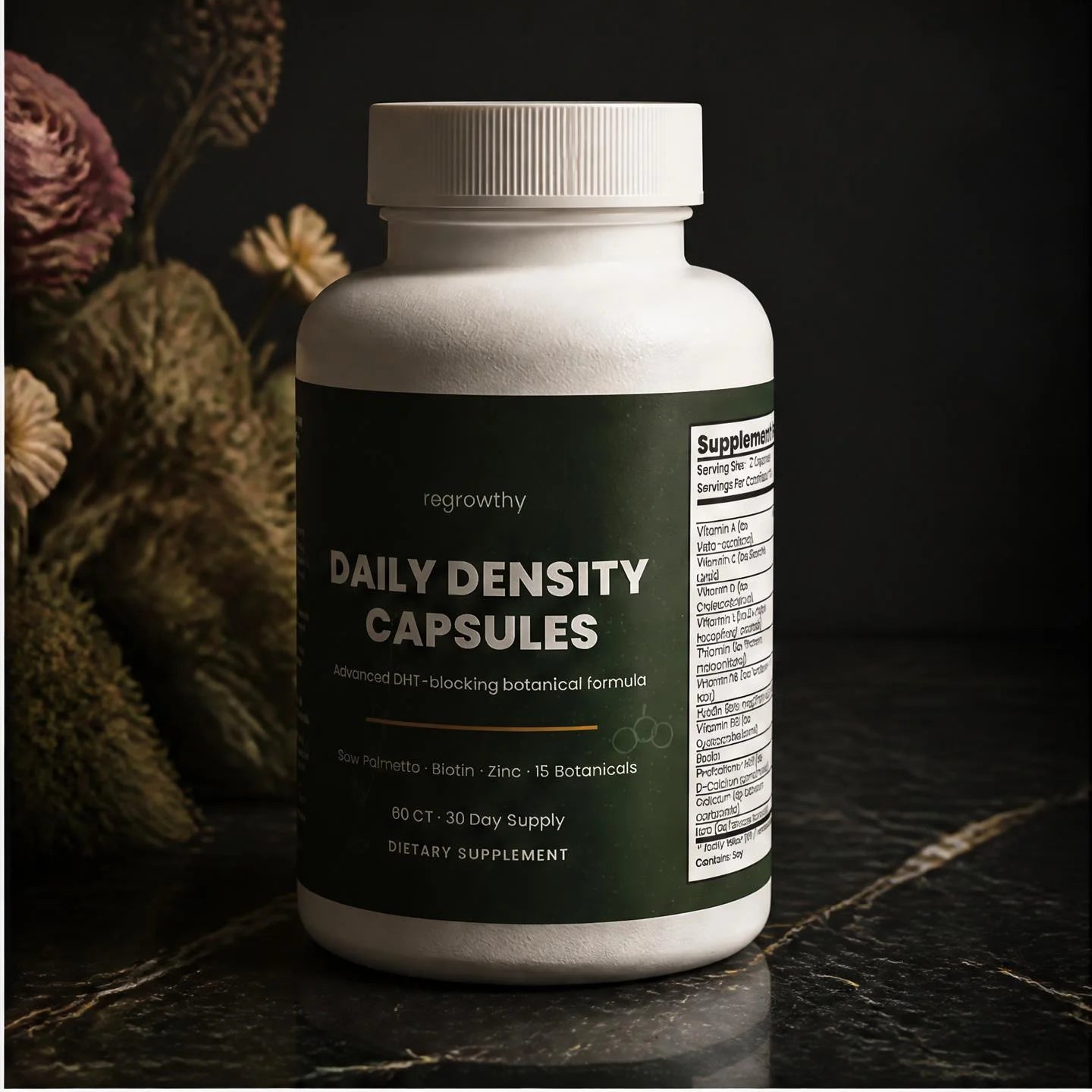
Because vitamin D rarely works alone, formulas that pair it with other hair-supportive nutrients, such as biotin's role in keratin production, zinc, and the trace mineral covered in this look at selenium and follicle health, tend to make more practical sense than a standalone vitamin D pill for someone specifically focused on hair. Daily Density Pro Capsules were formulated with this kind of overlap in mind, combining vitamin D with a broader set of follicle-supporting nutrients rather than asking you to piece together five separate bottles on your own.
Combining Vitamin D With a Full Hair Health Strategy
Vitamin D can meaningfully help with diffuse shedding tied to deficiency, but it is rarely the whole story once genetics and hormone-driven follicle sensitivity are involved. If your hair loss follows a classic pattern, a receding hairline, a thinning crown, or a widening part that has been slowly progressing for years, correcting a vitamin D deficiency is still worth doing for your overall health, but it likely needs to be paired with an approach that addresses follicle miniaturization directly.
This is where combining strategies tends to outperform any single fix. Low-level light therapy, delivered through a device like the Laser Therapy Cap, works on a completely different mechanism than vitamin D or diet changes. It uses red light around 660nm to stimulate cellular energy production in the follicle, encouraging more hair to stay in the anagen phase for longer. Used consistently alongside corrected vitamin D levels, this gives you a nutritional foundation and a direct follicle stimulus working together, rather than relying on one lever to do all the work.
If DHT sensitivity is part of your picture, and it is worth having that conversation with a dermatologist if pattern baldness runs in your family, ingredients like saw palmetto are sometimes used alongside nutritional support because they work on a different pathway entirely, moderating how strongly the follicle responds to hormones rather than addressing a nutrient shortfall. None of this replaces medical advice, but understanding which lever you are actually pulling helps you set realistic expectations. Vitamin D correction is a genuine, evidence-backed piece of a hair health plan. It is not a substitute for treating androgenetic hair loss if that is what is actually happening on your scalp.
If you take away one thing from all of this, let it be that hair loss is rarely caused by a single missing ingredient, but vitamin D is one of the few pieces that is cheap, low-risk, and genuinely worth confirming with a blood test rather than guessing at. Correct a real deficiency, give your follicles a few months to respond, and pair that foundation with whatever else your specific pattern of thinning actually requires. Patience plus the right inputs, in that order, is usually what separates people who see real regrowth from people who bounce between products without ever addressing what was actually going on underneath.
From the routine
Mentioned in this article
Common questions
Frequently asked questions
Can vitamin D deficiency really cause hair loss?+
How long does it take for hair to improve after correcting a vitamin D deficiency?+
What vitamin D level is considered too low for healthy hair growth?+
Should I take a vitamin D supplement even if I am not sure I am deficient?+
Does vitamin D help with all types of hair loss?+
Can I get enough vitamin D from sunlight alone without supplements?+
The Regrowthy System
Ready to start regrowing at home?
Hands-free. Non-prescription. 660nm clinical wavelength, backed by a 30-day guarantee.
Continue Reading
Ingredient Science
Rosemary Oil for Hair Growth: What the Research Actually Shows
9 min read
Ingredient Science
Biotin for Hair Growth: How It Works and Who Actually Needs It
9 min read
Ingredient Science
Zinc and Hair Loss: The Mineral Connection Explained
9 min read
Ingredient Science