Treatment Guides
How to Choose a Hair Loss Treatment: A Decision Framework
With dozens of hair loss products competing for your attention, picking the right one feels overwhelming. This decision framework walks you through diagnosis, options, tradeoffs, and how to build a routine that actually fits your life.
Updated July 1, 2026

Search "how to choose a hair loss treatment" and you'll get thousands of results, most of them written by someone trying to sell you exactly one answer. The truth is less convenient but more useful: there is no universal best hair loss treatment for everyone, only the best hair loss treatment for your specific hair, stage of loss, health history, and lifestyle. This guide is a decision framework, not a product pitch. Work through it step by step and you'll land on a plan that fits you, not just whatever ranked first in a search result.
We'll cover how to get an accurate read on what's actually happening with your hair, the major categories of treatment available today, how to weigh the real tradeoffs between them, and how to combine approaches sensibly instead of gambling everything on a single bottle or pill.
Why There's No Single "Best" Hair Loss Treatment
Hair loss is not one condition. Androgenetic alopecia (the technical name for common male and female pattern hair loss) behaves differently depending on genetics, hormone sensitivity, and how far along the miniaturization process already is. A man in his late twenties noticing a slightly higher hairline is not in the same situation as a man in his fifties with visible scalp showing through at the crown, and a woman with diffuse thinning across the part line is dealing with a different pattern entirely.
On top of that, people differ in what they're willing to tolerate. Some readers want the strongest possible intervention and don't mind the side-effect risk that comes with prescription drugs. Others specifically want a non-prescription treatment options guide because they've had a bad reaction to medication in the past, or they simply prefer to avoid systemic hormonal effects if a non-drug approach can still deliver meaningful results. Budget, time, and consistency also matter enormously: a treatment you'll actually stick with for a year beats a theoretically stronger one you abandon after six weeks.
That's why the question "what's the best hair loss treatment for me" needs a framework, not a single answer. The rest of this guide walks through that framework in order.
Step 1: Start With an Accurate Diagnosis
Before comparing products, figure out what you're actually treating. Most over-the-counter and non-prescription treatments are formulated for androgenetic alopecia, the slow, pattern-based thinning driven by genetic sensitivity to DHT (dihydrotestosterone) at the hair follicle. DHT binds to receptors in genetically susceptible follicles and gradually shrinks them in a process called miniaturization, which is why pattern hair loss tends to follow predictable zones: the temples and crown in men, and the part line in women.
Other causes look similar at first glance but respond to completely different treatments. Sudden, diffuse shedding a few months after illness, surgery, major stress, or childbirth is often telogen effluvium, which is usually temporary and self-resolving. Patchy, coin-shaped bald spots can indicate alopecia areata, an autoimmune condition that needs a dermatologist's involvement. Thinning concentrated at the temples with scalp tenderness sometimes points to traction alopecia from hairstyling habits.
If your loss is gradual, symmetrical, and follows a recognizable pattern (the Norwood-Hamilton scale for men, the Ludwig scale for women), you're very likely dealing with garden-variety androgenetic alopecia, and everything in the rest of this article applies directly to you. If your pattern is sudden, patchy, or accompanied by pain, scaling, or scarring, see a dermatologist before spending money on any treatment. A correct diagnosis is the single highest-leverage decision in this entire process.
Key Point
Diagnosis comes before product selection, not after. A treatment that's excellent for androgenetic alopecia will do very little for telogen effluvium or alopecia areata, so ruling out the less common causes first saves you months of guessing.
Step 2: Know Your Treatment Options at a High Level
Once you're confident you're dealing with pattern hair loss, it helps to see the full menu of legitimate options laid out honestly, rather than through the lens of whoever's ad you clicked last. Broadly, they fall into a few categories.
- Prescription oral and topical medication. Finasteride (oral) and prescription-strength topical minoxidil are the two treatments with the longest clinical track record for slowing pattern hair loss. They require a prescription in most cases and carry a documented, if uncommon, side-effect profile.
- Over-the-counter topical minoxidil. Available without a prescription, applied daily, effective for many people but requiring indefinite ongoing use to maintain results.
- Low-level laser and red light therapy devices. Non-prescription, worn or applied for a set number of minutes several times a week, with a growing body of clinical research supporting photobiomodulation as a way to stimulate follicle activity without systemic drug exposure.
- Topical and oral natural actives. Ingredients like saw palmetto and rosemary oil have real, if more modest, research behind their ability to interfere with DHT activity or support scalp circulation.
- Nutritional support. Vitamins, minerals, biotin, and collagen peptides that address deficiencies or support the biological building blocks of hair, generally used as an adjunct rather than a standalone fix.
- Scalp care. Shampoos and cleansers formulated to reduce DHT and buildup at the follicle level, plus surgical options like hair transplantation for advanced cases, which sit outside the scope of this guide but are worth knowing exist.
If you're specifically weighing a topical drug against a device-based approach, our detailed comparison of minoxidil and red light therapy goes deeper into how those two specific categories stack up.
Step 3: Match the Treatment to Your Situation
With the categories in front of you, the next step is filtering by what actually applies to your life, not just what's clinically strongest on paper.
Stage of loss
Early, subtle thinning responds well to almost any legitimate treatment, because there are still enough healthy follicles to protect and strengthen. Advanced loss with significant scalp visibility narrows the realistic options and may call for a more aggressive combination approach, or a conversation with a dermatologist about medical options alongside anything non-prescription you're using.
Risk tolerance
Some people are comfortable with the side-effect profile of oral medication in exchange for its track record. Others aren't, and that's a completely reasonable position. If hormonal side effects are a dealbreaker for you, our breakdown of finasteride's documented side effects is worth reading before you rule anything in or out, since an informed no is just as valid as an informed yes.
Lifestyle and consistency
A treatment only works if you actually do it. Twice-daily topical liquid application that leaves residue on your pillow is a dealbreaker for some people and a non-issue for others. A device like a Laser Therapy Cap that you wear for a set number of minutes while doing something else, like reading or watching television, fits more easily into a busy schedule for a lot of readers, but it still requires showing up several times a week without fail.
Budget model
Some options are a one-time purchase, others are an ongoing prescription cost, and others are a subscription. Think in terms of cost per year, not just the sticker price you see first, since that's the number that actually determines whether you'll stay consistent.
Step 4: Weigh Cost, Commitment, and Side Effects
Every treatment category has a real tradeoff, and being honest about it upfront prevents a lot of wasted money and frustration later.
- Oral prescription medication tends to have the strongest clinical data for slowing pattern loss, but it comes with a documented, if uncommon, risk of sexual and mood-related side effects that some men decide isn't worth it, particularly younger men who haven't yet decided how they feel about a lifelong hormonal medication.
- Topical minoxidil is effective for a large percentage of users but requires indefinite daily application, can cause an initial shedding phase that discourages people who don't know to expect it, and results reverse within months of stopping.
- Laser and red light devices have a favorable side-effect profile since there's no systemic drug exposure, but they demand real time consistency, typically ten to twenty minutes several times a week, and the upfront cost is higher than a bottle of topical solution even though there's nothing ongoing to repurchase.
- Natural actives and supplements generally carry the lowest risk profile of any category, which makes them a sensible addition almost regardless of what else you're doing, but the evidence supporting them as a standalone treatment for meaningful regrowth is considerably thinner than for the categories above.
None of these tradeoffs make one category objectively "better." They make each category better suited to a particular person's priorities, which is exactly the point of working through this framework instead of chasing whatever's trending.
Step 5: Build a Routine, Not a Single Product
One of the most consistent findings across dermatology research is that combination approaches, tools that work through different mechanisms simultaneously, tend to outperform any single intervention used alone. That doesn't mean piling on every product you can find. It means picking one intervention from each category that makes sense for your situation and giving the combination time to work together.
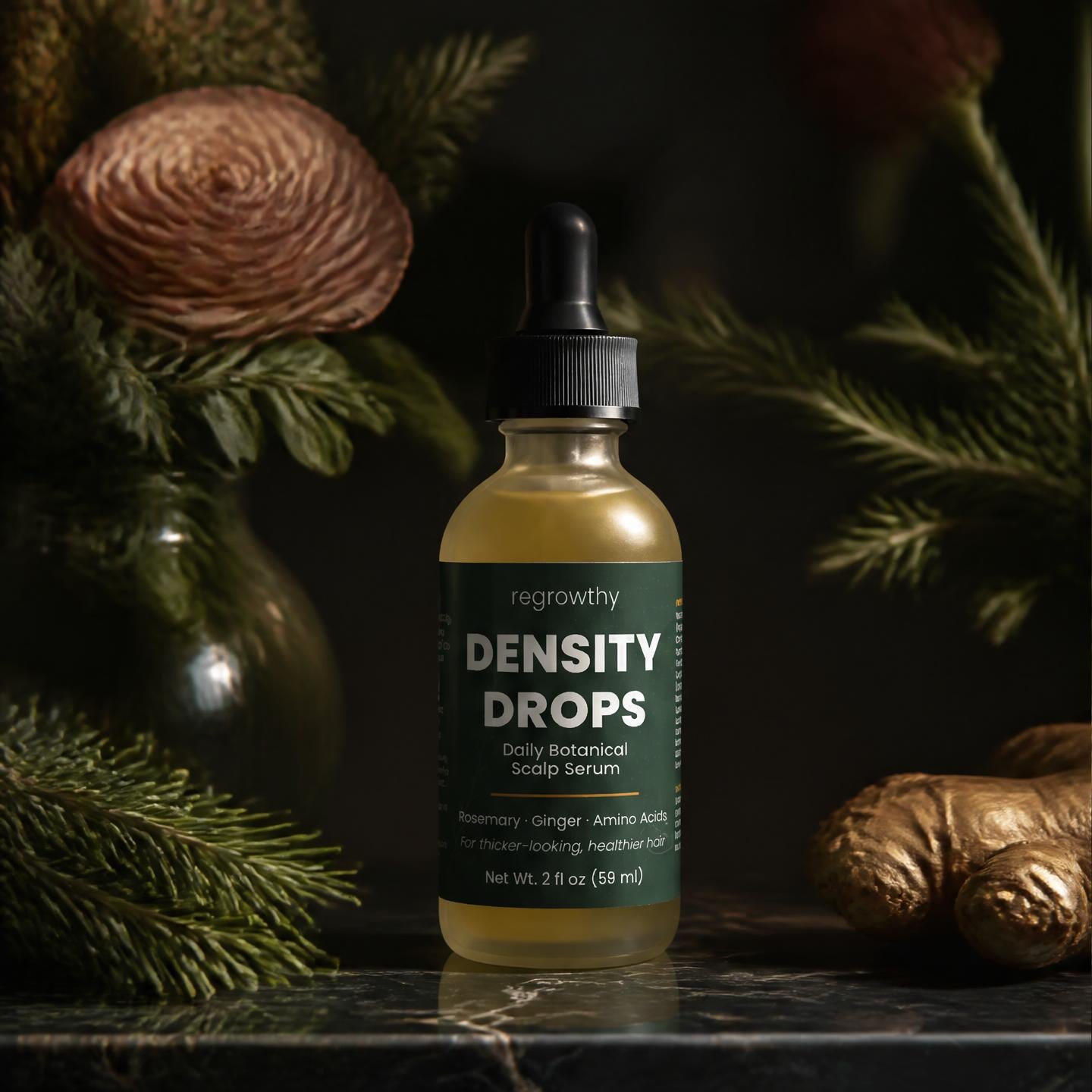
A sensible non-prescription routine, for example, might pair a device like the Laser Therapy Cap for consistent photobiomodulation sessions with a leave-in topical like Density Drops formulated around DHT-relevant actives such as saw palmetto, plus internal support from something like Daily Density Pro capsules or Daily Density Gummies to cover nutritional gaps, and a scalp-focused cleanser like Dense Cleanse to keep the follicle environment clear of buildup that can interfere with topical absorption. Someone more focused on hair strength and thickness alongside thinning might add Density Elixir or Density Collagen into that same routine rather than replacing anything already working.
The point isn't to buy everything at once. It's to recognize that a device, a topical, and internal support each address a different part of the picture, DHT sensitivity, scalp circulation, and the raw nutritional building blocks of hair, and that stacking sensible choices from each category is a more defensible strategy than betting everything on one product because an ad promised dramatic results.
Step 6: Set a Timeline and Track Your Results
Hair grows in cycles, and every follicle on your head is at a different point in that cycle at any given moment. That biology means no treatment, prescription or otherwise, shows visible results in a week or even a month. Clinical research on both topical and device-based treatments generally evaluates results at the three-month and six-month marks, and that's the realistic window you should be planning around too.
Take a baseline photo under consistent lighting before you start anything, then repeat it monthly. Progress in hair regrowth is slow enough that day-to-day comparison in the mirror is nearly useless, while a photo from three months ago next to one from today often makes a difference obvious that you'd otherwise miss. Some people also experience a temporary increase in shedding a few weeks into a new routine as the hair cycle resets; this is a well-documented, expected phase for several treatment types and not a sign that something is wrong.
If you've given a combination genuinely consistent effort for four to six months with photo evidence and see no change at all, that's the point to revisit your diagnosis, your consistency, or whether a prescription-strength option or dermatologist consultation makes sense as a next step. Adjusting the plan based on real data, not impatience after two weeks, is what separates people who eventually see results from people who bounce between products indefinitely.
Choosing a hair loss treatment isn't about finding the one product every review site agrees is best. It's about being honest with yourself about your diagnosis, your risk tolerance, your schedule, and your budget, then building a routine around those honest answers instead of around marketing. Work through the six steps here in order, give whatever you choose a real, tracked window of time, and you'll end up with a plan that's actually sustainable, which in hair regrowth is the single biggest predictor of whether a treatment works.
From the routine
Mentioned in this article

Common questions
Frequently asked questions
How do I know if I have pattern hair loss or something else?+
What's the best hair loss treatment for me if I want to avoid prescription medication?+
Can I combine multiple hair loss treatments at once?+
How long before I know if a hair loss treatment is working?+
Is it normal to shed more hair after starting a new treatment?+
Do natural ingredients like saw palmetto and rosemary oil actually work for hair loss?+
The Regrowthy System
Ready to start regrowing at home?
Hands-free. Non-prescription. 660nm clinical wavelength, backed by a 30-day guarantee.
Continue Reading

Treatment Guides
Minoxidil vs. Red Light Therapy: Which Is Better?
12 min read
Treatment Guides
Finasteride Side Effects: What Every Man Should Know
11 min read
Treatment Guides
Minoxidil: The Complete Guide to How It Works and What to Expect
9 min read
Treatment Guides