Treatment Guides
Finasteride: The Complete Guide to How It Works and What to Expect
Finasteride is one of the most studied treatments for hormone-driven hair loss, but knowing how it actually works and what timeline to expect makes all the difference. Here is a clear, honest breakdown of the science, the results timeline, and what to consider before starting.
Updated July 1, 2026
If you've spent any time researching hair loss treatments, you've almost certainly run into finasteride, the medication sold under the brand name Propecia. This finasteride complete guide walks through exactly how the medication works, what a realistic results timeline looks like, and what to expect before deciding if it's right for you.
Whether you found your way here through a doctor's recommendation, a friend's experience, or your own late-night research, understanding the science behind finasteride can help you make a clearer, calmer decision about your hair, instead of relying on marketing claims or forum anecdotes.
What Is Finasteride?
Finasteride is an oral prescription medication originally developed to treat enlarged prostates. Researchers testing it at higher doses noticed a side effect worth paying attention to: it also slowed hair loss in the men taking it. In 1997, the FDA approved a low-dose version, 1 milligram daily, specifically for treating male pattern hair loss. That version became known by its brand name, Propecia, though affordable generic finasteride is now widely available through pharmacies and telehealth providers.
Finasteride belongs to a class of drugs called 5-alpha reductase inhibitors, and it remains one of only two medications with FDA approval for treating androgenetic alopecia, the clinical term for the most common type of pattern hair loss (the other being topical minoxidil). Unlike most over-the-counter products, finasteride doesn't just sit on the scalp, it works from the inside, targeting the hormonal process that drives thinning in the first place.
A higher-dose version of the same drug, sold as Proscar, is still used for prostate conditions today. The hair loss dose is simply a fraction of that amount, which is part of why understanding the mechanism matters before you start taking it.
How Finasteride Works
To understand why finasteride helps, it helps to understand what causes male pattern hair loss in the first place. Hair follicles on the scalp are sensitive to a hormone called dihydrotestosterone, or DHT, which forms when an enzyme called 5-alpha reductase converts testosterone into DHT. In men who are genetically predisposed to pattern hair loss, DHT binds to receptors in the follicle and gradually shrinks it, a process dermatologists call miniaturization.
Over time, miniaturized follicles produce shorter, finer, and less pigmented hairs until they eventually stop producing visible hair at all. This is the same underlying progression mapped out in the Norwood scale, the standard system used to classify stages of male pattern hair loss.
Finasteride works by blocking the type II form of the 5-alpha reductase enzyme, which reduces how much testosterone gets converted into DHT. Clinical research suggests this can lower scalp DHT levels substantially in men who take it consistently. With less DHT reaching the follicle, the miniaturization process slows or stops, and in many men, follicles that were shrinking are able to recover some size and produce visibly thicker hair over time.
It's worth being clear that finasteride does not address every cause of thinning hair. It's built specifically for hormone-driven hair loss, not hair loss caused by stress, nutritional gaps, thyroid conditions, or autoimmune issues like alopecia areata. Knowing the difference matters, because a treatment that works beautifully for androgenetic alopecia will do nothing for a different underlying cause.
Finasteride Results Timeline
One of the most common questions about this medication is simple: how long until it actually works? The honest answer is that finasteride is slow, and understanding a realistic finasteride results timeline can save you from giving up too early or expecting a dramatic before-and-after in a matter of weeks.
- Months 1 to 3: Most men see no visible change yet. A small number notice temporary increased shedding during this window, as older hairs cycle out to make room for new growth. This is generally considered a normal part of the process, not a sign that something is wrong.
- Months 3 to 6: Shedding typically slows, and some men start to notice their hair loss has at least stopped progressing, even if regrowth isn't obvious yet.
- Months 6 to 12: This is when most clinical studies begin measuring meaningful improvement in hair count and thickness. Photos taken at this point compared to baseline photos often show a visible difference, even when day-to-day change felt unnoticeable.
- 12 months and beyond: Improvement tends to continue gradually, with many men reaching their fullest results somewhere between one and two years of consistent use.
Because finasteride works by keeping DHT levels suppressed, its benefits depend on continued use. Stopping the medication generally allows DHT levels to return to baseline within weeks, and hair loss tends to resume its previous course within six to twelve months. This is one of the most important things to understand before starting: finasteride is a long-term commitment, not a short course of treatment you complete and move on from.
Key Point
Give it a full year before judging results. Most dermatologists recommend evaluating finasteride only after 12 consistent months of daily use, since hair growth cycles are slow and monthly photos in the same lighting are a far more reliable gauge of progress than checking the mirror every day.
Who Is Finasteride For?
Finasteride is FDA-approved specifically for men with androgenetic alopecia, typically showing up as thinning at the crown or a receding hairline. It tends to work best for men who catch thinning in its earlier stages, when follicles are miniaturized but still active. Men with long-standing bald patches and little visible fine hair often see less dramatic results, since there may be little living follicle left to rescue.
Finasteride is not approved or recommended for women, particularly women who are pregnant or may become pregnant, since the medication can cause serious birth defects in a developing male fetus, even through skin contact with a crushed or broken tablet. Women dealing with hair thinning should talk to a doctor about alternative approaches rather than using finasteride off-label without medical supervision.
Because it's a prescription medication, starting finasteride requires a conversation with a doctor, dermatologist, or licensed telehealth provider who can review your medical history, confirm you're a reasonable candidate, and monitor you over time. If finasteride isn't the right fit for your situation, or you'd simply rather avoid a daily prescription, it's worth exploring the full range of options, including surgical versus non-surgical approaches to hair restoration.
Potential Side Effects
Like any medication, finasteride carries a risk of side effects, and being informed about them is part of making a responsible decision. The most discussed risks involve sexual side effects, including reduced libido, difficulty with erections, or changes in ejaculate volume. Clinical trials have generally found these effects occur in a minority of men and are often reversible after stopping the medication, though a subset of men have reported symptoms persisting after they stopped taking it, something sometimes referred to as post-finasteride syndrome. This remains an area of ongoing research and medical debate, and it's a legitimate reason some men choose to avoid oral finasteride altogether or discuss it thoroughly with a doctor before starting.
Other reported side effects can include mood changes, breast tenderness, and skin reactions, though most men who take finasteride report no side effects at all. Because everyone's body responds differently, it's worth having an honest conversation with a healthcare provider about your personal risk factors, and reporting any new symptoms rather than pushing through them silently.
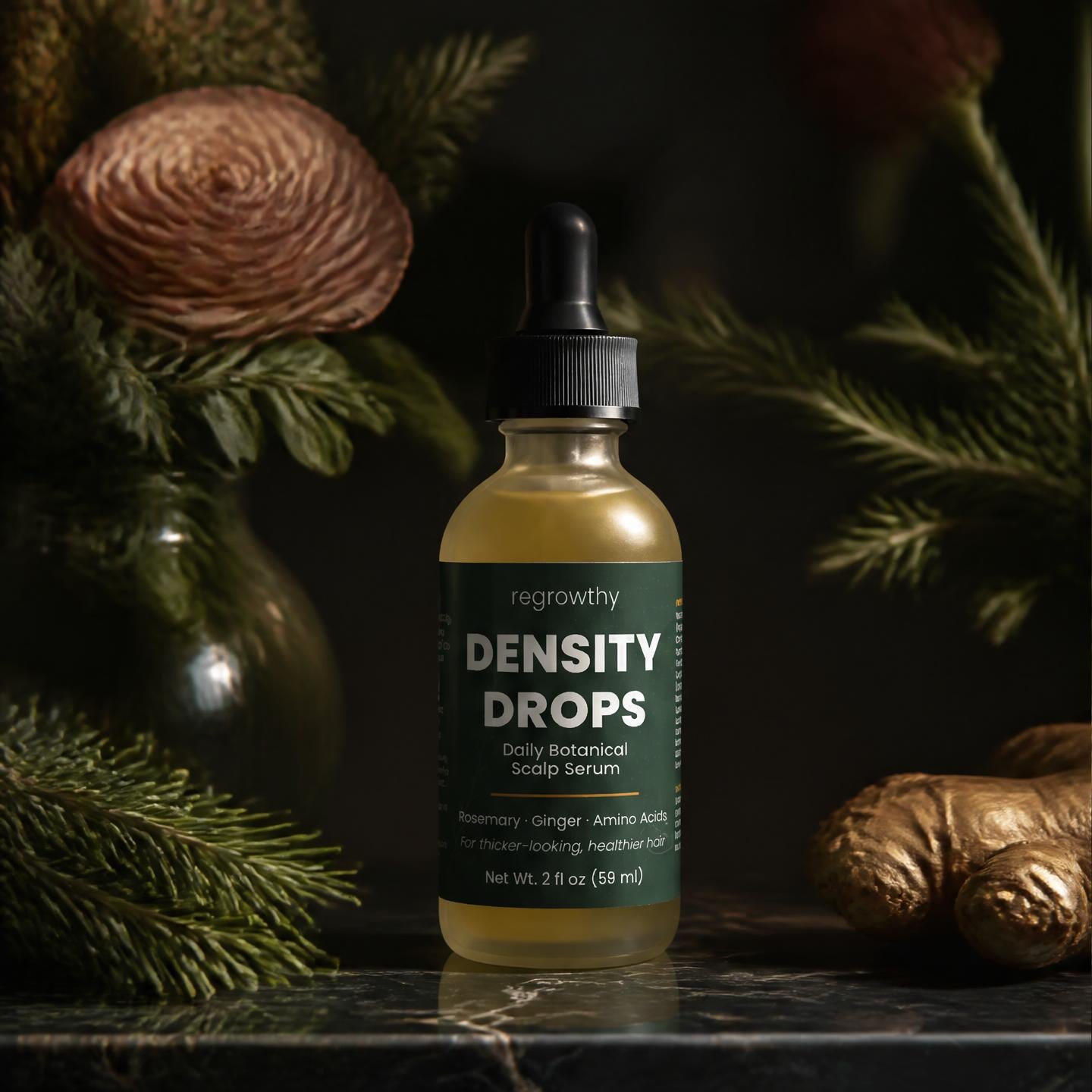
This is exactly why many men build a broader routine rather than relying on a single prescription. Non-hormonal tools, like a Laser Therapy Cap that uses red light to support circulation and follicle activity, or a topical formula such as Density Drops that pairs botanical DHT-supporting ingredients like saw palmetto with nourishing actives, can be used on their own or alongside finasteride to support results without adding another systemic medication into the mix.
Finasteride vs Other Hair Loss Treatments
Finasteride is often mentioned in the same breath as topical minoxidil, and the two are frequently used together since they act on different mechanisms: finasteride reduces DHT production, while minoxidil is thought to improve blood flow to the follicle and extend its active growth phase. Many dermatologists consider the combination more effective than either treatment alone. For a closer look at how oral and topical approaches compare in practice, this comparison of topical versus oral treatments breaks down the practical differences in more detail.
Compared to low-level laser therapy, finasteride works through an entirely different pathway. A laser cap doesn't touch hormone levels at all; instead, it uses specific wavelengths of red light, generally around 660 nanometers, to stimulate cellular activity in the follicle, which some research suggests can support hair density over time. Because laser therapy doesn't carry the same systemic risk profile as an oral medication, it's often used as a first step, or as a complement for men who want to be conservative about introducing hormonal treatments into their routine.
Natural and supplement-based ingredients, like saw palmetto or rosemary oil, are sometimes framed as gentler alternatives because they may have a mild effect on similar hormonal pathways, though the evidence behind them is far less robust than the clinical data supporting finasteride. They can be reasonable additions to a routine, but it's honest to say they aren't a direct substitute for a clinically studied prescription medication when hormonal hair loss is significant.
Getting Started With Finasteride
If you've decided finasteride is worth trying, the first step is a conversation with a doctor, dermatologist, or telehealth provider who can prescribe it after reviewing your health history. Most providers will ask about family history of hair loss, current medications, and any history of prostate, liver, or mental health conditions, since these can factor into whether finasteride is appropriate for you.
Once you start, consistency matters more than almost anything else. Taking the medication at the same time each day, not skipping doses, and committing to at least a full year before judging results gives finasteride the best chance to work. Many men find it helpful to take monthly photos in the same lighting and from the same angles, since gradual change is much easier to see in side-by-side comparisons than in a daily mirror check.
It also helps to build supporting habits around the medication rather than treating it as a standalone fix. A healthy scalp environment, gentle cleansing, good circulation, and solid nutritional support all play a role in hair health that a hormone-blocking medication alone doesn't cover. Pairing finasteride with a clean, sulfate-free routine like Dense Cleanse, or a daily supplement approach such as Daily Density Pro, can address the parts of hair health, like scalp condition and micronutrient support, that finasteride was never designed to touch.
Finasteride isn't a quick fix, and it isn't the right choice for everyone, but for men dealing with hormone-driven hair loss, it remains one of the most extensively studied tools available today. Understanding how it works, what a real results timeline looks like, and where it fits alongside devices, topicals, and supplements puts you in a much better position to build a routine that actually matches your hair, your goals, and your comfort level with a daily prescription.
From the routine
Mentioned in this article

Common questions
Frequently asked questions
How long does it take to see results from finasteride?+
What happens if I stop taking finasteride?+
Is finasteride the same as Propecia?+
Can women take finasteride for hair loss?+
Can finasteride be combined with other hair loss treatments?+
Are the side effects of finasteride permanent?+
The Regrowthy System
Ready to start regrowing at home?
Hands-free. Non-prescription. 660nm clinical wavelength, backed by a 30-day guarantee.
Continue Reading