Product Comparisons
HairMax vs Regrowthy: Laser Comb vs Full-Coverage Laser Cap
HairMax built its name on handheld combs and LaserBands you sweep across your scalp yourself. Here is how that hands-on approach compares to a full-coverage laser cap you simply put on and forget about.
Updated July 1, 2026

HairMax is one of the oldest names in at-home laser hair therapy, best known for its handheld combs and, more recently, the LaserBand devices you wave across your scalp in narrow strips. Regrowthy takes a different approach entirely: a full-coverage laser cap that treats the entire scalp at once, no combing motion required. If you are comparing HairMax vs Regrowthy, the decision really comes down to one question: do you want a device you actively guide across your head, or one you put on and forget about for the length of a session?
This comparison looks at how each device actually works, what a laser comb session involves versus a laser cap session, and which type of user each format tends to suit. No fabricated statistics, no specific competitor pricing, just an honest look at two different ways of delivering the same underlying therapy: low-level laser light at the wavelength dermatology research associates with hair follicle stimulation.
How HairMax Works
HairMax built its reputation on the handheld laser comb, a device with a small row of laser diodes and a set of teeth you drag through your hair in sections, holding the comb still for a few seconds at each spot before moving to the next. The company later introduced the LaserBand line, a curved, banded device meant to cover more scalp per pass than the original comb, cutting session time down while keeping the same "guide it yourself" format.
Both formats are FDA-cleared devices and use low-level laser therapy, the same general category of treatment used in full-coverage caps. The core mechanism is the same across the category: laser light at a specific red wavelength is thought to stimulate mitochondrial activity in hair follicle cells, a process generally referred to as photobiomodulation. Where HairMax differs is in delivery. Because the comb or band only illuminates a narrow strip at a time, you are responsible for methodically working it across your entire scalp, section by section, to make sure no area gets skipped.
That manual coverage requirement is the defining trait of the laser comb vs laser cap conversation. A comb or band can deliver an effective dose of light to the hair it touches, but only to the hair it touches. Coverage is a function of how carefully and consistently you move the device, not something the device guarantees on its own.
How the Regrowthy Laser Cap Works
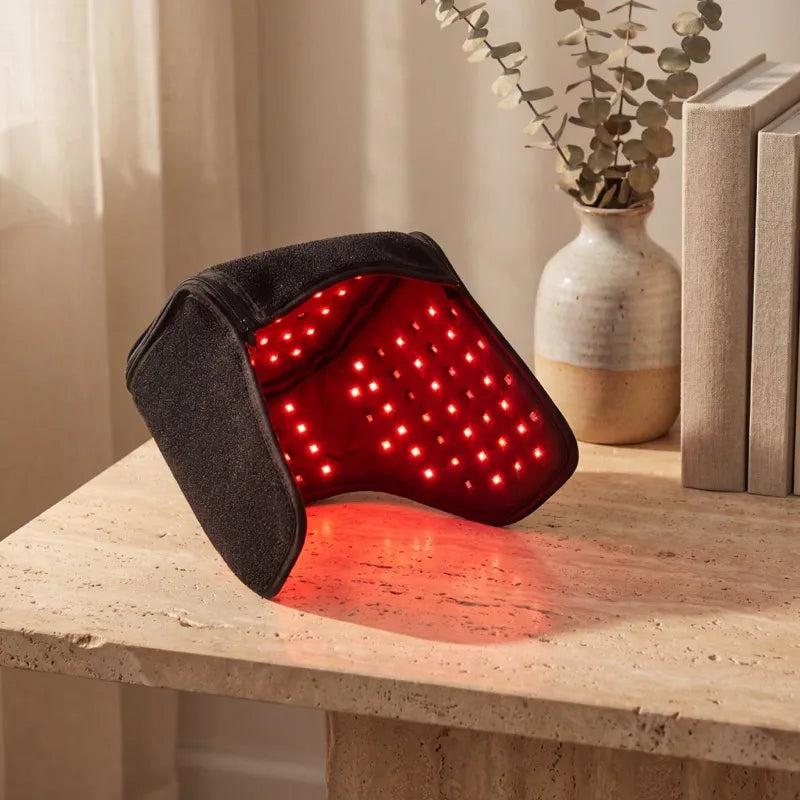
The Laser Therapy Cap takes the opposite approach to coverage. Instead of a narrow comb or band you sweep across your head, it is a helmet lined with more than 200 laser diodes at the 660nm wavelength, positioned to reach the crown, the temples, and the hairline simultaneously. You put it on, start the built-in timer, and every diode is doing its job for the full session, no repositioning and no risk of missing a patch of thinning scalp because you moved on to the next section too soon.
This matters because androgenetic alopecia rarely thins in a single tidy zone. Most men and women see gradual recession at the temples, diffuse thinning at the crown, and a widening part line, often all at once and often asymmetrically. A device that requires you to manually trace those zones puts the burden of thoroughness on you, every single session, for months. A full-coverage cap removes that variable.
The cap is also just one part of a broader routine rather than a standalone gadget. Regrowthy pairs the device with Daily Density Pro Capsules, a saw palmetto-based formula intended to address DHT from the inside, plus topical and nutritional options across The Density Line for readers who want more than a single device addressing a single mechanism.
Session Experience: Active vs Hands-Free
This is where the two products feel most different in daily life. A HairMax comb or LaserBand session requires your active attention. You are holding the device, moving it in a pattern, timing each section, and keeping it pressed close enough to the scalp to work through hair. You cannot easily read, work, or walk around the house mid-session, since your hand and eyes are occupied managing the device itself.
A laser cap session works differently. Once it is on and the timer has started, your hands are free. You can answer email, watch something, cook dinner, or just sit and read while the cap does the full-scalp work on its own. For a treatment that needs to be used consistently, several times a week, for months before results become visible, this difference in daily friction adds up. A routine you have to actively babysit is a routine that is easier to skip on a busy day. A routine you can layer into something you were already doing is a routine you are more likely to stick with for the long haul.
Key Point
The single biggest difference in the laser comb vs laser cap decision is not the light itself, it is how much manual effort is required to get consistent full-scalp coverage. A comb or band depends on you tracing every thinning zone by hand each session. A full-coverage cap treats the whole scalp automatically, which matters most for anyone dealing with diffuse or multi-zone thinning rather than one isolated patch.
Coverage and Consistency Over Time
Clinical research on low-level laser therapy for hair loss generally measures outcomes based on consistent, sustained use over several months, not a single session or even a single month. That means the format that makes it easiest to stay consistent, and easiest to guarantee even coverage every time, has a practical advantage that goes beyond the light source itself.
With a handheld comb or band, coverage consistency depends entirely on user technique. Rush through a session, skip a row, tilt the device too far from the scalp, and that pass delivers less light to those follicles than intended. Over dozens of sessions across several months, small inconsistencies can compound. A full-coverage cap removes most of that variability by design: the diode layout is fixed, so as long as the cap fits snugly and the session runs its full length, coverage is the same every time.
This is not a knock on HairMax as a company. Handheld and banded laser devices have a long track record and a loyal following, and for someone dealing with a small, localized area of thinning, a targeted comb may feel like the more precise tool. But for the diffuse, multi-zone thinning pattern that describes most cases of androgenetic alopecia, full coverage tends to be the more practical fit.
Cost Structure and Long-Term Commitment
Both HairMax devices and the Regrowthy laser cap are one-time hardware purchases rather than subscriptions, which sets the entire laser therapy category apart from prescription routes like finasteride or minoxidil that require ongoing monthly spend indefinitely. That is a meaningful shared advantage worth acknowledging on both sides of this comparison. Specific competitor prices shift often enough that quoting a number here would likely be stale by the time you read this, so the more useful comparison is structural: what you get for the one-time purchase.
A handheld comb or band is a single-purpose device. It delivers laser light and nothing else. Regrowthy's cap is sold as part of a wider system: the device itself, a scalp preparation kit, and an available subscription line of supplements including Density Drops and Daily Density Pro if you want to combine internal and topical support with the light-based treatment. That supplement side is optional and priced as its own subscription, so you are never forced into recurring costs just to use the cap, but it is there for readers who want a fuller routine than a device alone provides.
If you have already researched other full-coverage devices, it is worth reading how Regrowthy stacks up against Theradome and Kiierr as well, since those are the more direct cap-to-cap comparisons rather than the comb-to-cap format difference covered here.
Who Should Choose HairMax
A HairMax comb or LaserBand can make sense if you are specifically looking for a hairmax alternative to nothing, meaning you have not tried laser therapy before and want to start with a lower-commitment, single-purpose device. It may also suit someone with a small, well-defined thinning area who is comfortable spending a few extra minutes per session methodically working the device across that zone, and who prefers a brand with a long history in the handheld laser category specifically.
If you read a hairmax laserband review and the appeal is the brand's track record or you specifically want a device you actively hold and control rather than wear passively, that preference is a legitimate reason to lean toward HairMax.
Who Should Choose Regrowthy
The Laser Therapy Cap tends to fit better if your thinning shows up in more than one place, the classic combination of a receding hairline plus crown thinning, or general diffuse density loss across the scalp. It also fits better if your daily schedule makes a hands-free session more realistic than one requiring active device manipulation for the full treatment window. Anyone weighing hairmax vs regrowthy who wants to fold in a broader routine, DHT-targeted supplementation via Daily Density Pro, topical support, or scalp care alongside the light therapy itself, will find Regrowthy's system-based approach more built for that than a standalone comb.
If you are simply looking for full-scalp coverage without having to learn a sectioning technique or worry about missing a spot, the cap format removes that entire category of user error from the equation.
The Bottom Line
HairMax has a long, credible history in at-home laser hair therapy, and its comb and LaserBand devices are legitimate, FDA-cleared tools for people who want a targeted, hands-on treatment approach and do not mind the extra time and technique required to cover the full scalp properly. That is a fair trade for some users, particularly those dealing with a smaller or more localized thinning pattern.
For readers dealing with the more common diffuse or multi-zone thinning pattern, the full-coverage design of the Laser Therapy Cap removes the manual-coverage burden entirely, turns each session into something you can do while doing something else, and connects to a wider system of supplements if you want to address hair health from more than one angle. Neither format is a miracle cure, and both require realistic expectations and consistent use over several months before you should expect to judge results.
Ultimately, the laser comb vs laser cap decision comes down to how you want to spend your treatment time each week: actively guiding a device across your scalp, or putting on a cap and getting on with your day while it works the whole scalp at once. Understanding that difference is the most useful thing you can take away from any HairMax vs Regrowthy comparison.
From the routine
Mentioned in this article
Common questions
Frequently asked questions
Is a laser comb or a full-coverage laser cap better for hair loss?+
How long does a HairMax LaserBand session take compared to the Regrowthy cap?+
Can I switch from a HairMax device to a laser cap without starting over?+
Does HairMax or Regrowthy require a prescription?+
Is the Regrowthy cap a good hairmax alternative if I have a busy schedule?+
Does Regrowthy include anything beyond the laser cap itself?+
The Regrowthy System
Ready to start regrowing at home?
Hands-free. Non-prescription. 660nm clinical wavelength, backed by a 30-day guarantee.
Continue Reading
Product Comparisons
iRestore vs Regrowthy: Laser Hair Therapy Devices Compared
8 min read
Product Comparisons
Rogaine vs Regrowthy: The Daily Commitment vs The Complete Routine
10 min read
Product Comparisons
Theradome vs Regrowthy: Laser Helmet Comparison
9 min read
Product Comparisons