Product Comparisons
DS Laboratories Spectral vs Regrowthy: Topical Serums Compared
DS Laboratories built its Spectral serums around Nanoxidil and a long ingredient list, while Regrowthy takes a botanical, non-prescription route with Density Drops. Here is a fair, side by side look at what each topical actually offers.
Updated July 1, 2026
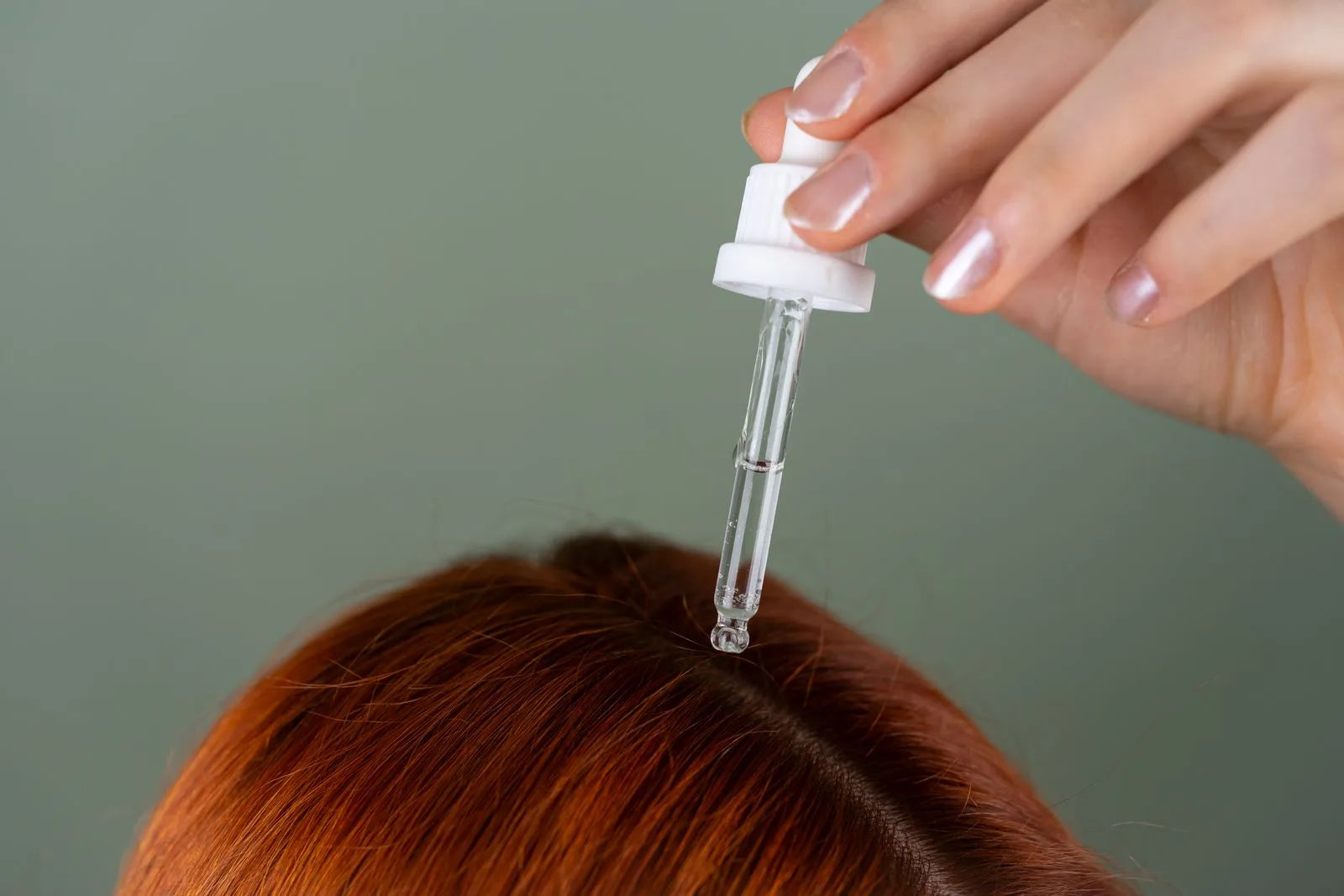
If you have spent any time researching topical hair serums, you have probably come across DS Laboratories and its Spectral line. Spectral.DNC-N and Spectral.CSF are two of the best known cosmetic scalp serums on the market, built around a compound called Nanoxidil and a long list of supporting actives. They are popular, they are backed by a company that has been formulating scalp products for years, and they represent a real, credible option in the topical hair loss space. This article compares that approach to Regrowthy's own topical step, Density Drops, and to the broader multi-modal system Regrowthy builds around it.
This is not a takedown. DS Laboratories has built a genuinely respected brand, and plenty of people use Spectral serums as their entire hair care routine. But a serum, however well formulated, is still one input applied to the scalp. The question worth asking before you buy is not just "which serum has more ingredients," but "what is this serum trying to do, and what am I comfortable relying on it to do alone."
What DS Laboratories Spectral Actually Is
DS Laboratories markets several serums under the Spectral name, and the lineup can be confusing at first glance. Spectral.DNC-N is the most widely discussed product, formulated around Nanoxidil, a compound the company developed as a minoxidil-adjacent topical ingredient, delivered through a nanosome delivery system alongside a mix of supporting botanicals and peptides. Most discussion of spectral serum hair loss results centers on this exact product, since it is the flagship of the line. Spectral.CSF adds procyanidin B-2 and other actives aimed at follicle stimulation. There is also a line that pairs certain formulations with topical finasteride available through some telehealth channels, which puts a portion of the DS Laboratories catalog into prescription territory rather than purely cosmetic.
This matters for anyone doing a straight topical hair serum comparison. Some Spectral products are sold as cosmetic serums with no prescription required. Others sit closer to the compounded, prescription-adjacent model that companies like hims and Keeps use for minoxidil and finasteride combinations. Reading the specific product page carefully before you order is worth the extra five minutes, since "Spectral" is a brand name that spans more than one type of product.
How the Two Approaches Compare
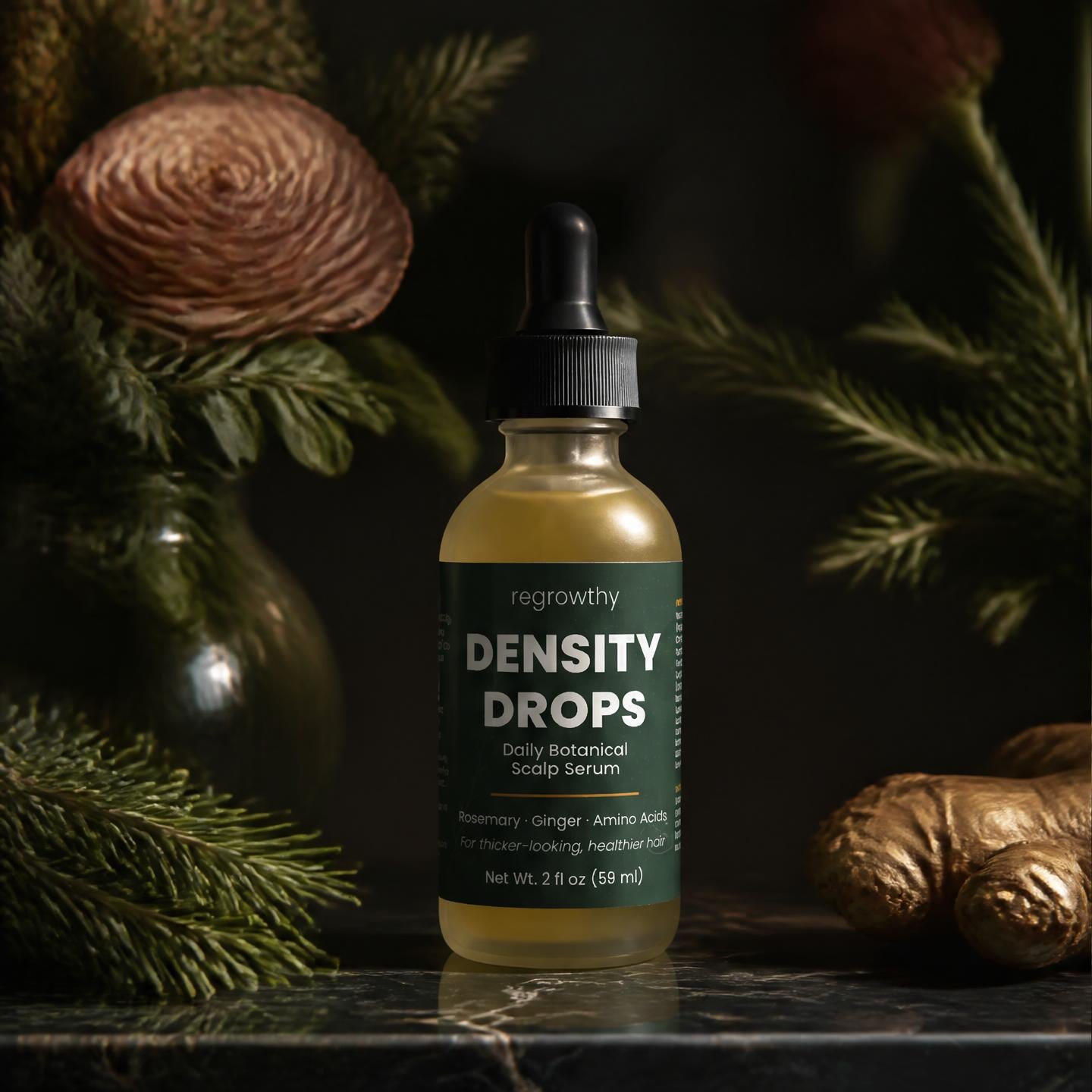
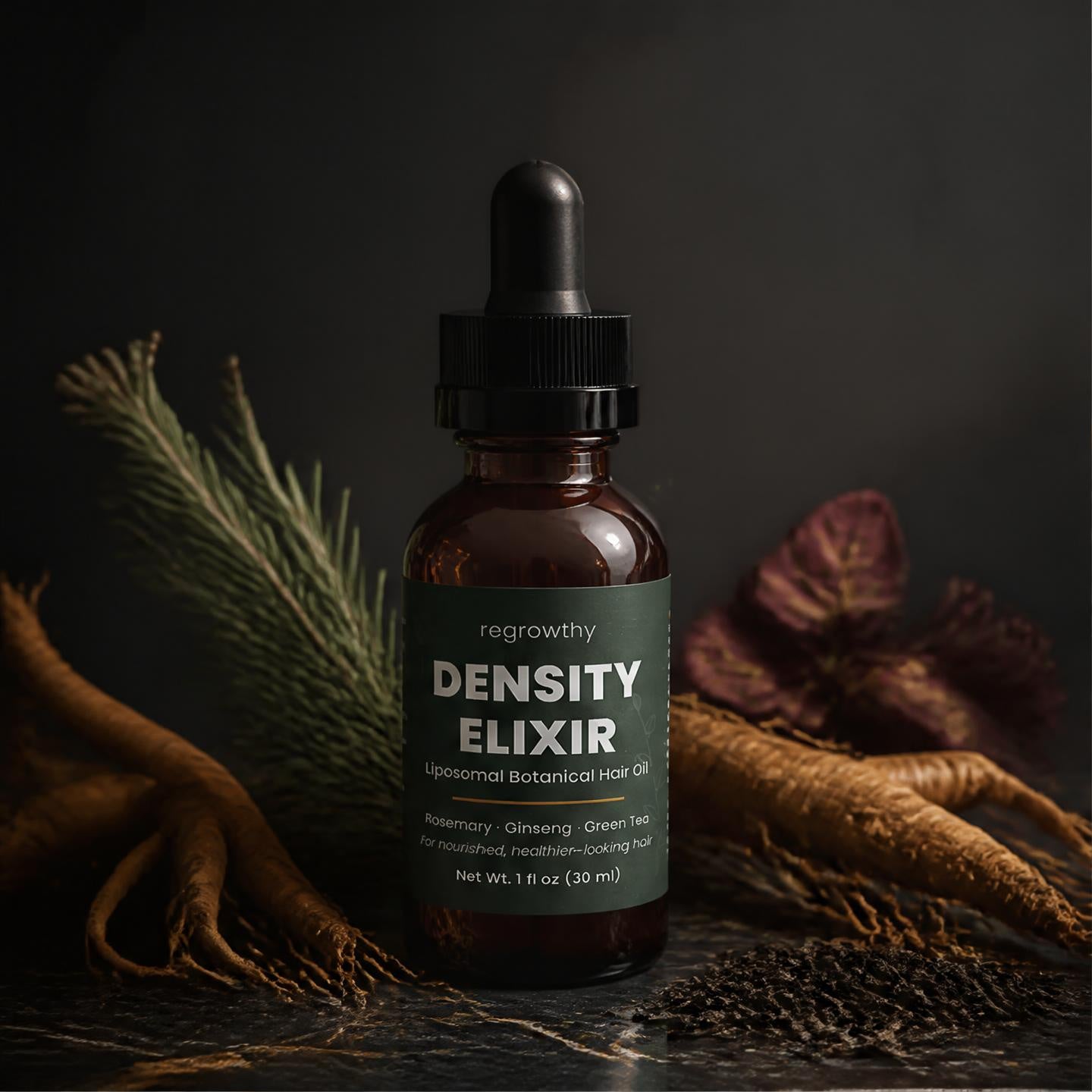
Regrowthy's topical step is Density Drops, a rosemary-led botanical serum, alongside Density Elixir for a heavier, overnight-style application. Neither is positioned as a Nanoxidil competitor claiming a novel synthetic delivery mechanism. Instead, they lean on well-studied botanical actives, rosemary oil chief among them, applied directly to the scalp as part of a daily routine.
- Formulation philosophy: Spectral leans on a proprietary synthetic compound (Nanoxidil) plus a long ingredient list. Density Drops leans on a shorter list of well-documented botanicals, rosemary oil in particular.
- Product scope: DS Laboratories sells a range of serums, shampoos, and in some cases prescription-adjacent formulas. Regrowthy sells a topical serum as one piece of a coordinated system that also includes a laser device and oral supplements.
- Purchase model: Depending on the specific Spectral product, you may be buying a straightforward cosmetic serum or working through a telehealth intake for a prescription-adjacent version. Density Drops is a non-prescription cosmetic serum sold direct, with a subscription option.
- Standalone vs multi-modal: Spectral is generally used as a complete routine on its own. Density Drops is designed to be paired with the Laser Therapy Cap and Daily Density Pro capsules rather than carry the whole routine by itself.
Key Point
A topical serum, whether it is Spectral or Density Drops, treats the scalp surface. It cannot address follicle energy at the cellular level the way light-based therapy can, and it cannot support the hormonal and nutritional side of hair thinning the way an oral supplement can. Whichever serum you choose, think about what else your routine needs, not just which bottle to buy.
Ingredient Philosophy: Synthetic Compound vs Botanical Base
Nanoxidil is DS Laboratories' signature ingredient, and the company has built a fair amount of brand identity around it as a gentler alternative to minoxidil with less reported scalp irritation for some users. It is a legitimate point of differentiation, and if you have tried minoxidil and reacted poorly to it, a Nanoxidil-based serum is a reasonable thing to try next.
Density Drops takes a different route. The formula centers on rosemary oil, which dermatology research has looked at directly against minoxidil in small trials, with rosemary performing comparably on hair density measures while producing fewer reports of scalp itching and irritation over the study period. Density Drops is not trying to be a synthetic drug substitute. It is a botanical topical designed to support scalp circulation and follicle environment as one layer of a broader routine, and its non-prescription, plant-based formulation is part of the appeal for people who specifically want to avoid synthetic actives on their scalp.
Neither philosophy is objectively correct. If you respond well to Nanoxidil and prefer a more clinical, ingredient-dense serum, Spectral is worth trying. If you would rather build your topical step around a botanical with a simpler ingredient story, Density Drops fits that preference better.
Prescription-Adjacent vs Fully Non-Prescription
This is where the two brands diverge most clearly. Part of the DS Laboratories catalog, particularly the products paired with topical finasteride, requires a telehealth consultation and a prescription, even if the process is handled quickly online. That means an intake questionnaire, a review by a licensed provider, and ongoing dependence on that provider relationship to keep refilling.
Every product in The Density Line, including Density Drops, is formulated as a non-prescription cosmetic product. There is no intake form, no waiting on a provider's approval, and no risk of a prescription lapsing. For someone who wants to start a topical routine today without going through telehealth, that is a meaningful practical difference, separate from any question of which formula works better for a given person.
If you have already been through a dermatologist or telehealth provider and have a comfortable relationship with a prescription-based Spectral product, there is no strong reason to switch that away. But if you have been putting off starting a topical routine because you do not want to deal with a consultation, the non-prescription Density Drops removes that barrier entirely.
Subscription Structure and What You're Actually Paying For
Both DS Laboratories and Regrowthy run on a recurring purchase model, which is standard for any topical serum you are expected to apply daily for months. We won't quote specific DS Laboratories prices here since serum pricing shifts often and third-party listings are frequently out of date. What is worth comparing instead is what each subscription actually gets you.
A DS Laboratories subscription typically gets you the serum itself, sometimes bundled with a companion shampoo from their line. A Regrowthy subscription to Density Drops can be paired, at the customer's choice, with Dense Cleanse shampoo and Daily Density Pro capsules, and stacked with a one-time purchase of the laser cap. The serum is priced as one component of a larger system rather than as the whole answer.
Neither model is inherently better value in the abstract. If all you want is a serum, paying for a serum-only subscription makes sense. If you are building a full routine, it is worth comparing the total monthly cost of assembling a serum, a shampoo, and a supplement separately against a system that was designed to work together from the start.
What a Topical Serum Cannot Do Alone
This is true of Spectral, Density Drops, and every other scalp serum on the market: a topical product applies actives to the skin's surface and the immediate follicle environment. It does not reach the mitochondrial energy production inside the follicle the way photobiomodulation does, and it does not address the internal, whole-body factors, nutrient status, stress, and androgen sensitivity, that an oral supplement targets.
This is the core argument for a multi-modal routine rather than a serum-only one. Regrowthy's laser cap uses 660nm red light to stimulate cytochrome c oxidase in follicle mitochondria, a mechanism that is well documented in the photobiomodulation literature and that a topical serum, whatever its ingredient list, is not designed to replicate. On the internal side, Daily Density Pro includes saw palmetto, a botanical that inhibits the same 5-alpha reductase enzyme pathway behind DHT-driven follicle miniaturization, addressing hair loss from a hormonal angle a serum cannot touch. If you would rather chew than swallow a capsule, Density Collagen peptides and Daily Density Gummies cover similar nutritional ground in different formats. For a closer look at how a device-based routine stacks up against other at-home systems, our comparison of HairGuard vs Regrowthy covers similar ground from the device side.
None of this means a serum is a waste of money. It means a serum works best as one layer, not the entire strategy, regardless of whether that serum is Spectral or Density Drops.
Who Each Option Actually Fits
DS Laboratories Spectral makes sense if you specifically want a Nanoxidil-based serum, you have already had a poor experience with minoxidil and want a gentler synthetic alternative, or you are comfortable with a telehealth intake for the prescription-adjacent versions. It also makes sense if a serum-only routine is genuinely what you are looking for, without a device or supplement layered on top.
Regrowthy's system fits better if you want to avoid any prescription step entirely, if you would rather build around a botanical topical than a synthetic compound, or if you are looking to combine a topical serum with a laser device and an internal supplement rather than treat the serum as your whole routine. It is also a fit if cost transparency matters to you, since every Density Line product is priced and sold directly with no telehealth markup built in.
Neither answer is wrong. It comes down to whether you are looking for a single best-in-class serum or a coordinated routine where the serum is one working part among several.
The Bottom Line
DS Laboratories has earned its reputation in the topical hair serum space, and any honest ds laboratories review has to acknowledge that Spectral products are formulated by people who know the category well. If you want a dedicated, ingredient-dense serum and are comfortable with a telehealth step for the prescription-adjacent formulas, it is a legitimate choice.
Where Regrowthy differs is in scope, not necessarily in serum quality alone. Density Drops is built to be one part of a system that also includes red light therapy and oral botanical support, all without a prescription requirement anywhere in the routine. If you are comparing spectral dnc vs regrowthy purely as serums, you are comparing a synthetic-compound formula to a botanical one, a reasonable personal preference either way. But if you are comparing the full picture of what each brand offers a person dealing with thinning hair, Regrowthy's non-prescription, multi-modal approach gives you more to work with for the same daily commitment.
Hair loss rarely responds to a single input in isolation, which is exactly why treating a serum as one piece of a routine, rather than the entire routine, tends to produce better outcomes over time. Whichever topical you choose, pair it with a plan for the mechanisms it was never designed to reach on its own.
From the routine
Mentioned in this article
Common questions
Frequently asked questions
Is DS Laboratories Spectral a prescription product?+
What is the main difference between Spectral and Density Drops?+
Can I use a topical serum without a laser cap or supplements?+
Does Regrowthy sell anything comparable to Spectral.CSF?+
Why doesn't this article list specific DS Laboratories prices?+
Is a botanical serum like Density Drops as effective as a Nanoxidil formula?+
The Regrowthy System
Ready to start regrowing at home?
Hands-free. Non-prescription. 660nm clinical wavelength, backed by a 30-day guarantee.
Continue Reading
Product Comparisons
Capillus vs Regrowthy: FDA-Cleared Laser Caps Compared
8 min read
Product Comparisons
iRestore vs Regrowthy: Laser Hair Therapy Devices Compared
8 min read
Product Comparisons
Scalp Med vs Regrowthy: Topical Kit Comparison
9 min read
Product Comparisons