Product Comparisons
Scalp Med vs Regrowthy: Topical Kit Comparison
Scalp Med built its reputation on a minoxidil-based topical kit sold direct to consumers. Here is an honest look at how it compares to Regrowthy's non-prescription, multi-modal approach.
Updated July 1, 2026

If you have spent any time researching over-the-counter hair loss treatments, you have probably come across Scalp Med. It has been marketed directly to consumers for years as an all-in-one topical hair loss kit, built around minoxidil as the active ingredient, packaged with a companion serum and sold through infomercial-style advertising. It is one of the older names in the category, and a lot of people searching "scalp med review" are trying to figure out if the kit still holds up against newer options.
Regrowthy takes a different shape entirely. Instead of one topical kit built around a single active ingredient, Regrowthy combines a laser therapy cap with a topical serum and an internal supplement line. Both brands are non-prescription and both are sold direct to the consumer, so the comparison is a fair one: two accessible, at-home approaches to thinning hair, built on different mechanisms.
This article breaks down what Scalp Med actually is, what it costs, how its topical kit compares to Regrowthy's approach, and who each one is realistically built for. No hype, no miracle claims, just an honest side-by-side.
Scalp Med vs Regrowthy at a Glance
Before getting into the details, here is the high-level shape of the comparison. Scalp Med is a topical-only kit centered on minoxidil. Regrowthy is a broader system that pairs a light-based device with topical botanicals and oral support.
- Scalp Med is a topical hair loss kit sold direct to consumer, built around minoxidil with a companion serum, no prescription needed.
- Regrowthy is a multi-modal system combining a 660nm laser cap, a topical botanical serum, and an oral supplement line, also fully non-prescription.
- Both brands avoid the telehealth-prescription route entirely, which puts them in the same general "buy it yourself, no doctor visit required" category.
- The core difference is mechanism: Scalp Med relies on one active ingredient applied topically, while Regrowthy layers a device, a topical, and internal support together.
What Is Scalp Med
Scalp Med markets itself as a complete topical hair loss kit. The core of the system is typically a minoxidil solution, the same FDA-approved topical ingredient found in generic and brand-name minoxidil products, paired with a proprietary serum that the brand says helps the scalp better absorb the active treatment. The pitch is straightforward: apply the kit daily, and over months of consistent use, thinning areas may show improved density.
Minoxidil itself has a long track record. It was originally developed as an oral blood pressure medication, and topical formulations were later found to stimulate hair growth, likely by widening blood vessels in the scalp and extending the growth phase of the hair cycle. It remains one of the most studied over-the-counter treatments for androgenetic alopecia in both men and women, and it does not require a prescription in its standard concentrations.
Where a lot of "scalp med review" searches lead is to the same set of honest tradeoffs that apply to any minoxidil-based regimen. It needs to be applied daily, indefinitely, to maintain results. Some users experience scalp irritation, dryness, or unwanted facial hair growth from product transfer. And results, when they come, tend to be gradual, typically visible only after several months of uninterrupted use.
Scalp Med Cost and What You Actually Get
Scalp med cost is a common concern for people comparing it against other options, and like most direct-to-consumer topical kits, the actual price depends heavily on which package and continuity plan you select at checkout. Introductory kits are often advertised at a lower upfront price, with the real ongoing cost showing up once the auto-replenishment cycle kicks in for refill bottles of the solution and serum.
This is a common structure across the topical hair loss kit category generally, not unique to any one brand: a lower-friction entry price gets you in the door, and the recurring cost of staying on the regimen is where the real math happens. It is worth reading the fine print on any auto-ship topical kit before committing, since minoxidil-based treatments only work while you are actively using them. Stopping typically means any gained density is not maintained.
Key Point
Because we cannot verify a competitor's current pricing in real time, and because prices and package structures change, the fairest comparison is not dollar-for-dollar but model-for-model. Ask whether you are comfortable with an indefinite topical-only routine versus a system that combines a device with topical and oral support, and let that answer guide your decision more than a specific number would.
How Regrowthy's System Works
Regrowthy was built around the idea that hair thinning has more than one input, so a single topical solution is only addressing part of the picture. The system layers three mechanisms that work through different biological pathways rather than asking one ingredient to do all the work.
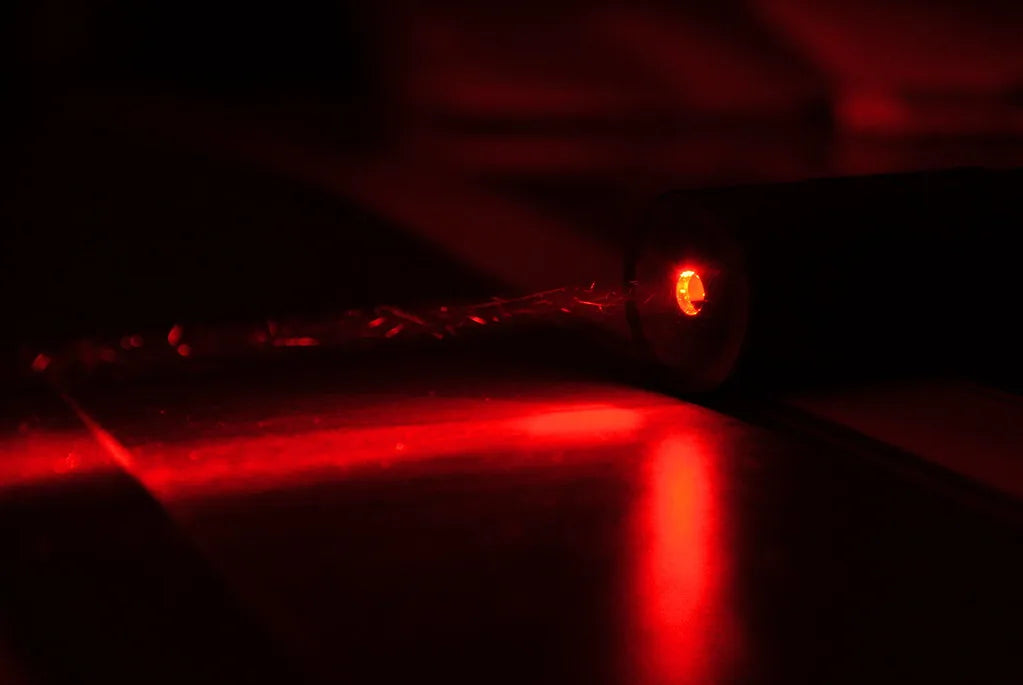
The first is the Laser Therapy Cap, a 660nm LED device worn for a short session several times a week. Low-level light therapy at this wavelength is thought to stimulate mitochondrial activity within hair follicle cells, increasing cellular energy production and helping miniaturized follicles re-enter an active growth phase. Clinical research on red and near-infrared light therapy for hair density has grown substantially over the past decade, and unlike a topical solution, it involves no daily product application to the scalp at all.
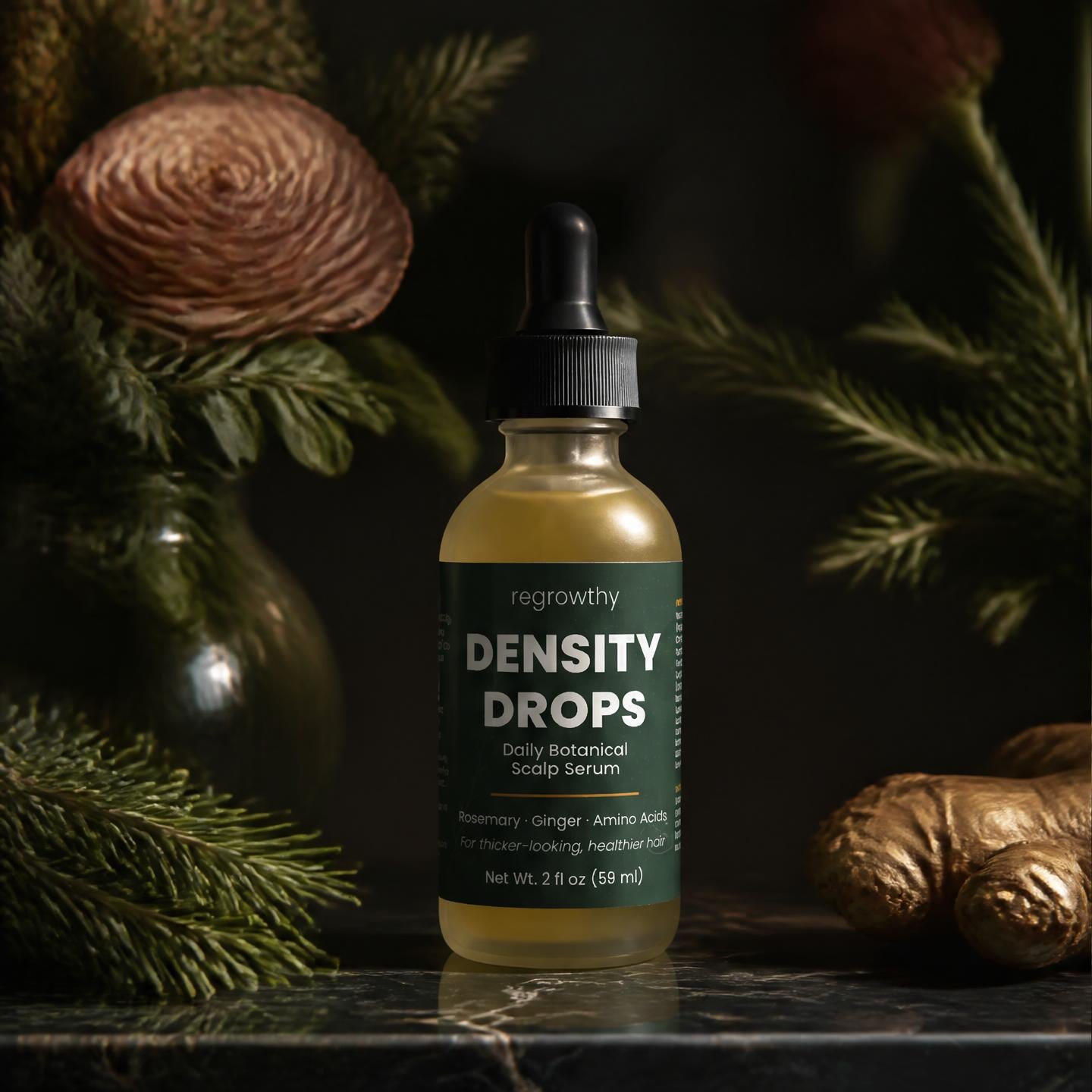
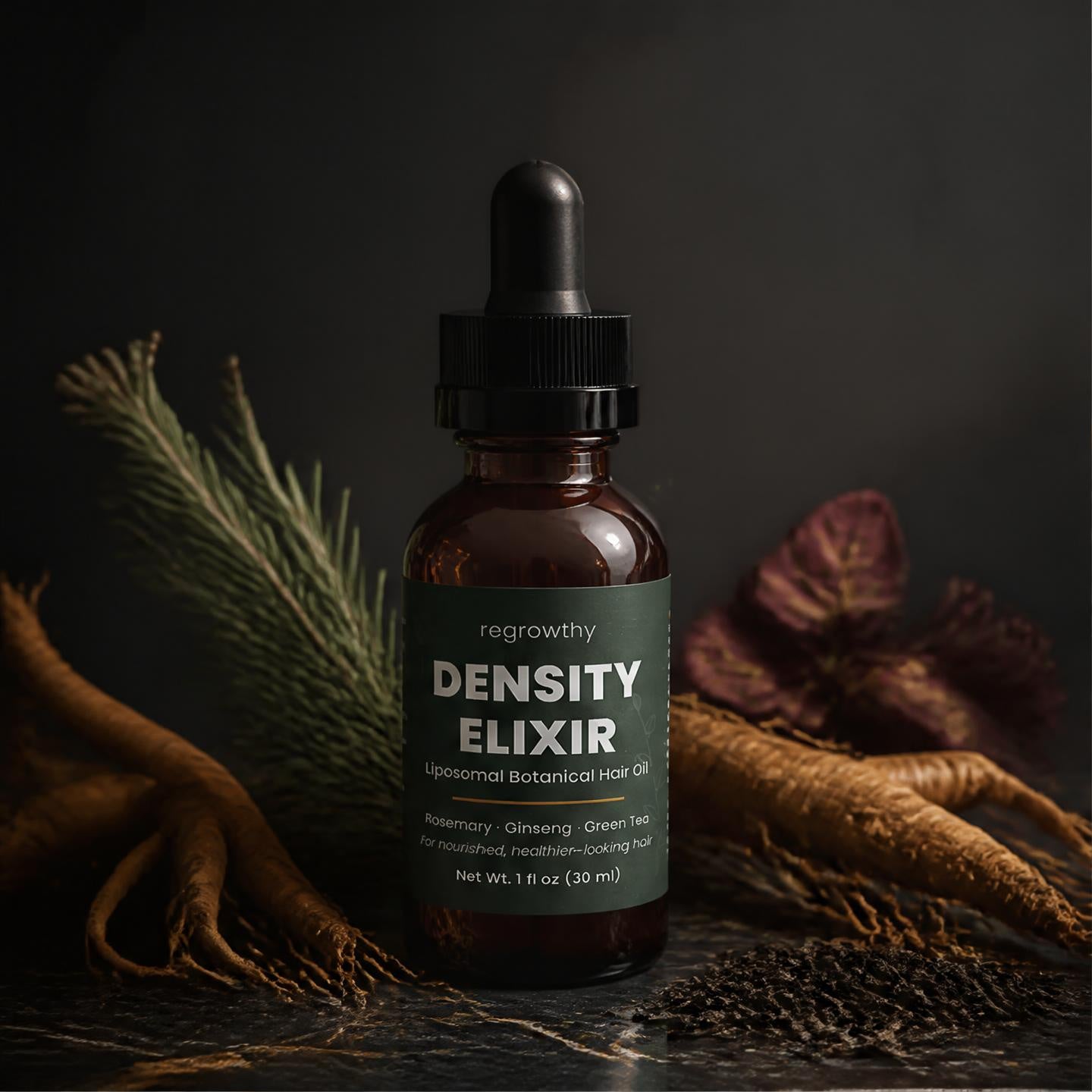
The second layer is topical botanical support through Density Drops, formulated with rosemary oil, which dermatology studies have found may perform comparably to low-concentration minoxidil in some head-to-head research, generally with less reported irritation. The third layer is internal support from Daily Density Pro Capsules and the rest of The Density Line, which includes ingredients like saw palmetto, a botanical compound studied for its ability to modestly interfere with the conversion of testosterone to DHT, the hormone most closely linked to androgenetic hair miniaturization at the follicle level.
None of this requires a prescription, a lab visit, or a telehealth consultation. It is designed to be ordered and used entirely at home, which puts it in the same accessibility category as Scalp Med even though the mechanisms underneath are quite different.
Comparing the Two Topical Kits
If you narrow the comparison strictly to the topical hair loss kit component of each brand, meaning Scalp Med's minoxidil-and-serum kit against Regrowthy's Density Drops, the two share some structural similarities and diverge in others.
- Active approach: Scalp Med centers on minoxidil, a vasodilator-based mechanism. Regrowthy's Density Drops centers on rosemary oil and other botanicals, a different biological pathway that some research suggests produces similar density outcomes with a gentler irritation profile for many users.
- Standalone vs system: Scalp Med's topical kit is generally the whole regimen. Regrowthy's topical serum is one of three layers, working alongside the laser cap and internal supplementation rather than carrying the full workload alone.
- Application commitment: Both require consistent daily or near-daily application to see and maintain results. Neither is a one-time fix, and that is true of essentially every topical hair loss product on the market.
- Subscription structure: Both brands rely on a continuity or subscription model for the topical component, which is standard across this category since ongoing use is what the science actually calls for.
The honest takeaway is that neither topical kit is inherently "better" in a vacuum. Minoxidil has decades of clinical backing behind it. Rosemary oil has a smaller but genuinely promising body of research behind it and tends to be better tolerated by people with sensitive skin. The bigger differentiator between the two brands is not the topical serum itself, it is whether you want that topical to be your entire strategy or one part of a larger one.
Who Scalp Med Fits
Scalp Med makes sense for someone who wants a straightforward, minoxidil-based topical routine and does not want to manage multiple products or a device. If your priority is simplicity, a single daily application habit, and you are comfortable with the well-documented tradeoffs of minoxidil (possible irritation, the need for indefinite use, gradual timelines), Scalp Med's model is a reasonable and established one within the topical hair loss kit space.
Who Regrowthy Fits
Regrowthy tends to fit people who have already tried a single topical solution and want to add mechanisms rather than swap one for another. If you want a device-based option that does not involve applying a liquid to your scalp every day, the laser cap is worth exploring on its own. If you want to pair a gentler botanical topical with internal support rather than relying on one ingredient to carry the entire routine, The Density Line was built for exactly that.
It also tends to appeal to people who want to avoid minoxidil specifically, whether due to past irritation, sensitivity concerns, or simply a preference for botanical-first ingredients like saw palmetto and rosemary oil over a pharmaceutical vasodilator. If you have found Scalp Med's topical routine effective but want to see whether adding a non-topical layer like light therapy accelerates or supports what you are already doing, that is also a common reason people look at Regrowthy alongside an existing topical regimen. For a broader look at how device-based approaches stack up against other non-prescription options, our iRestore vs Regrowthy comparison covers similar ground from a different angle.
The Bottom Line
Scalp Med and Regrowthy are both non-prescription, direct-to-consumer options, which puts them on similar footing when it comes to accessibility. Scalp Med's strength is its simplicity: one topical kit, one active ingredient, one habit to build. Regrowthy's strength is breadth: a laser cap, a topical botanical serum, and an internal supplement working through three distinct mechanisms rather than one.
Neither approach is a guaranteed fix, and both require realistic expectations and consistent use over months, not days. If you want the most straightforward topical-only routine, Scalp Med's kit is a known quantity in the category. If you would rather build a fuller system around light therapy, a botanical topical, and daily internal support, Regrowthy's approach is designed to give you more than one mechanism working at once.
Whichever direction you lean, the most useful next step is usually the same: pick one approach, commit to it fully for several months, and track your results honestly before deciding whether to adjust course.
From the routine
Mentioned in this article
Common questions
Frequently asked questions
Is Scalp Med a prescription treatment?+
How much does Scalp Med actually cost per month?+
Can I use a laser cap and a topical minoxidil kit at the same time?+
Does Regrowthy contain minoxidil?+
Which option works faster, Scalp Med or Regrowthy?+
The Regrowthy System
Ready to start regrowing at home?
Hands-free. Non-prescription. 660nm clinical wavelength, backed by a 30-day guarantee.
Continue Reading
Product Comparisons
iRestore vs Regrowthy: Laser Hair Therapy Devices Compared
8 min read
Product Comparisons
Rogaine vs Regrowthy: The Daily Commitment vs The Complete Routine
10 min read
Product Comparisons
Hairguard vs Regrowthy: Derma Rollers vs Laser Therapy
9 min read
Product Comparisons