Product Comparisons
Nioxin vs Regrowthy: Cleansing System vs a Regrowth Routine
Nioxin built its name on scalp cleansing systems, but cleansing alone does not target DHT or stimulate follicles. Here is how it compares to a fuller regrowth routine.
Updated July 1, 2026

If you have stood in the shampoo aisle staring at a Nioxin box, you already know the pitch: a three-step scalp cleansing system that promises fuller-looking hair. It is one of the most recognized names in hair care, sold in drugstores and salons alike. But there is an honest question underneath the marketing that a lot of people searching "nioxin does it work" are really asking: is cleansing the scalp enough to actually slow hair loss, or is it mostly a cosmetic routine that makes existing hair look thicker without changing what is happening underneath the surface?
This comparison is not about declaring a winner in the abstract. It is about scope. Nioxin is a scalp cleansing system built around shampoo, conditioner, and a leave-on scalp treatment. Regrowthy is a broader regrowth routine built around a 660nm laser cap and The Density Line, a set of supplements and topicals designed to work on the biological drivers of thinning hair, not just the scalp surface. Understanding what each one is actually designed to do will tell you more than any side-by-side ingredient list.
What Nioxin Actually Is
Nioxin is a scalp care brand best known for its numbered System kits (System 1 through System 6, plus others), each formulated for a different hair type and degree of thinning. Every system generally follows the same three-step structure: a cleanser shampoo, a scalp therapy conditioner, and a leave-in scalp and hair treatment. The core idea is that a cleaner, less congested scalp, free of product buildup, excess sebum, and follicle-blocking residue, creates a better environment for the hair that is already growing.
That is a reasonable and fairly modest claim. Nioxin has never positioned itself as a treatment for androgenetic alopecia in the way a prescription medication or a clinical-grade device would. It is a cosmetic hair care system, regulated and marketed as such. Many of its formulas include peppermint oil, niacinamide, biotin, and various plant-derived conditioning agents intended to add volume and reduce the appearance of thinning through texture and body, rather than through a mechanism aimed at follicle miniaturization or DHT.
That distinction matters enormously once you start asking whether Nioxin can actually reverse or slow thinning, versus whether it can make the hair you have look and feel denser day to day.
Does Nioxin Work? What the Science Says
This is the crux of most "nioxin system review" searches, and it deserves a straight answer. Scalp cleansing itself is not without merit. Dermatology research has generally supported the idea that a healthy scalp environment, free from excess oil and buildup, is a reasonable baseline for healthy hair growth. Clogged follicles and scalp inflammation are not helpful conditions for hair, and a gentle, well-formulated cleansing routine can genuinely improve scalp comfort, reduce flaking, and make hair appear fuller by removing residue that weighs strands down.
What clinical research does not support is the idea that cleansing alone addresses the underlying causes of pattern hair loss. The most common form of thinning in both men and women, androgenetic alopecia, is driven primarily by DHTDHT (dihydrotestosterone) acting on genetically sensitive hair follicles over time, gradually shortening the growth phase and shrinking the follicle. This is well-established dermatological science, and it is a hormonal and follicular process, not a hygiene process. A scalp cleansing system, no matter how well made, is not designed to interrupt that pathway, and Nioxin does not claim that it does.
So does Nioxin work? For scalp health, texture, and the cosmetic appearance of fullness, many users report a real difference, particularly if buildup or oily scalp was contributing to limp-looking hair. For actually changing the trajectory of pattern thinning, it is not designed to and should not be expected to. That is not a knock on the brand so much as an honest description of what a cleansing system is built to do.
Key Point
A clean scalp is a good foundation, not a treatment. If your hair loss is hormonal or age-related thinning, cleansing alone will not address the follicle miniaturization driving it. Pairing scalp care with mechanisms that target growth cycles and DHT is a more complete approach.
Cleansing System vs Regrowth Routine
Here is the practical difference in plain terms. Nioxin is a scalp cleansing system. Its three steps all live on the surface: wash, condition, leave-in treatment. Regrowthy is built as a regrowth routine with two distinct mechanisms working together rather than one product doing everything.
The first mechanism is light-based. The Laser Therapy Cap uses 660nm red light, a wavelength studied for its ability to stimulate cellular activity in the hair follicle through a process called photobiomodulation. This is a physically different intervention than anything a shampoo can do, since it works by delivering light energy to the scalp and follicle over a consistent, timed session rather than rinsing something off or leaving a topical residue behind.
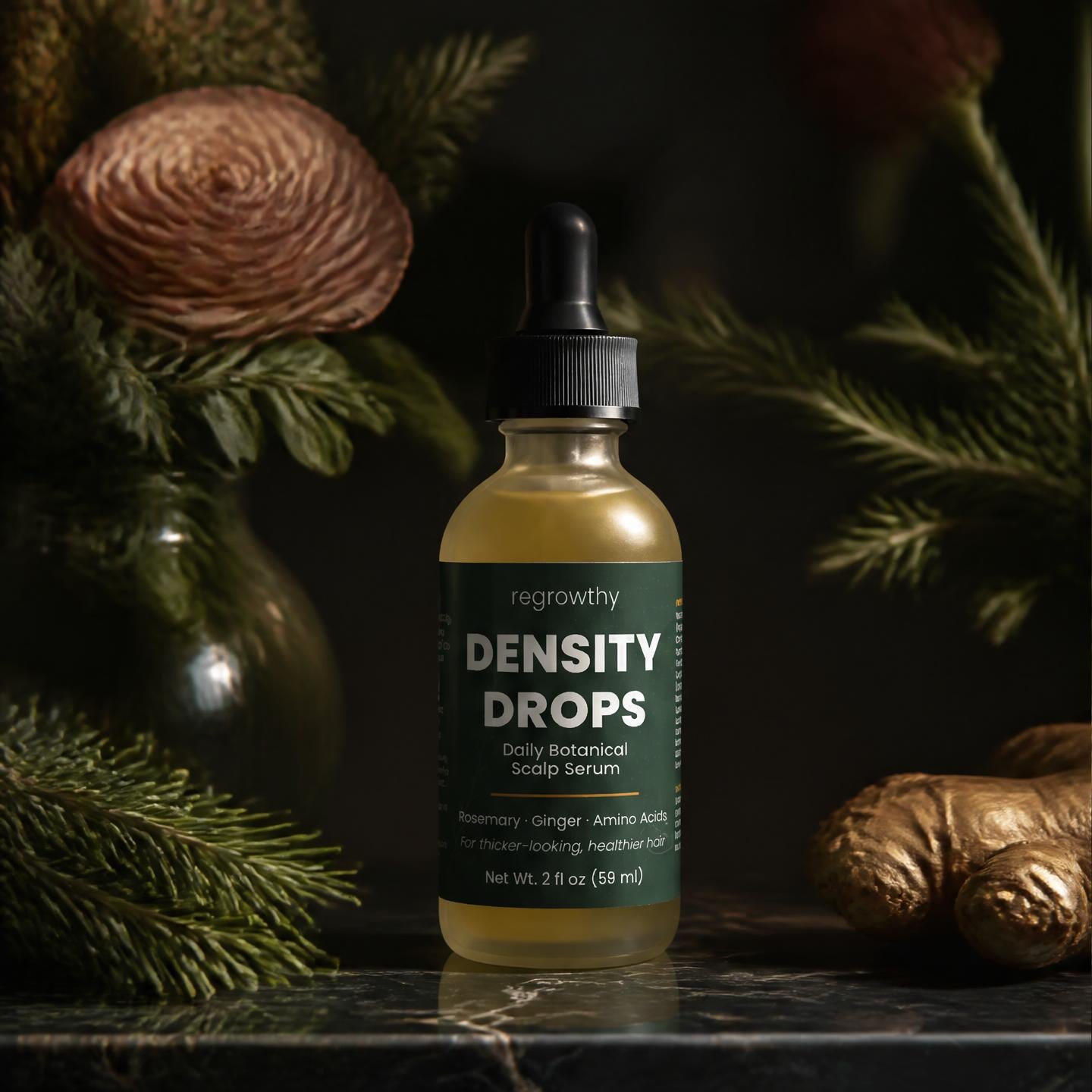
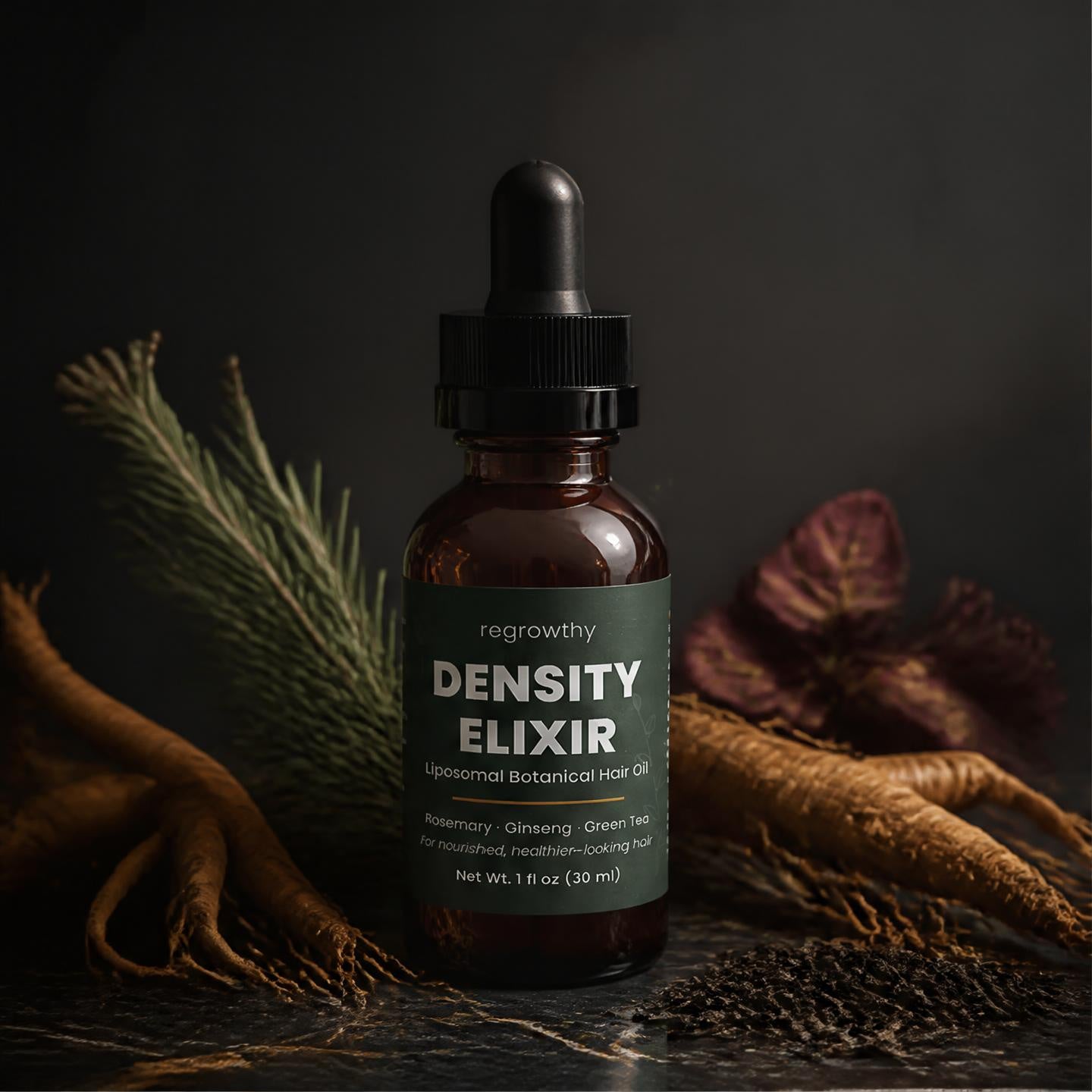
The second mechanism is internal and topical support through The Density Line. Where Nioxin's leave-in treatment sits on the scalp surface, products like Density Drops and Density Elixir are formulated to be absorbed and to support the scalp environment alongside oral supplementation. Daily Density Pro Capsules and Daily Density Gummies are built around ingredients like saw palmetto, which has been studied for its role in moderating DHT activity, giving the routine an internal angle that a cleansing system does not attempt to address.
If you want to compare this same "scope" question against other brands, it is worth reading how a topical-only system stacks up against a fuller routine, or how a topical serum compares to laser and supplement combined. The pattern repeats across categories: single-mechanism products versus multi-modal ones.
Ingredients: What Each Approach Targets
Nioxin formulas typically lean on cleansing agents, humectants, and scalp-conditioning botanicals like peppermint oil, along with niacinamide and biotin in some systems, ingredients associated with scalp comfort and hair texture rather than follicle-level hormonal activity. These are reasonable ingredients for what the product is trying to do: clean, condition, and add perceived volume.
Regrowthy's approach layers in ingredients more directly associated with the biology of thinning. Saw palmetto appears across several Density Line products for its studied relationship to DHT. Rosemary oil, which has drawn dermatological interest as a topical option researchers have compared to low-dose minoxidil in some small studies, appears in the topical formulations. Density Collagen Peptides address a different piece of the puzzle: the structural protein matrix that supports hair strength and the scalp's connective tissue, an angle that a cleansing shampoo, focused on the surface, is not formulated to touch.
- Nioxin: cleansing agents, peppermint oil, niacinamide, biotin (formula varies by system number)
- Regrowthy topicals: rosemary oil and botanical actives in Density Drops and Density Elixir
- Regrowthy oral: saw palmetto and supporting botanicals in Daily Density Pro and Daily Density Gummies
- Regrowthy structural support: Density Collagen Peptides for hair strength and connective tissue
- Regrowthy device: 660nm light therapy via the Laser Therapy Cap, a mechanism with no shampoo equivalent
None of this means Nioxin's ingredients are ineffective at their intended job. It means the two products are not really competing for the same job. One cleans and conditions. The other is trying to intervene earlier in the biological chain that causes thinning in the first place.
Cost and Commitment
Nioxin systems are sold as standalone bottles you replace as you run out, available at drugstores, salons, and online retailers without a subscription requirement. That makes it a low-commitment, low-friction addition to an existing hair care routine, something you can pick up without changing much else about how you approach hair loss.
Regrowthy's Density Line operates on a subscription model, which reflects that consistent daily use, not occasional application, is what the research behind ingredients like saw palmetto and rosemary oil generally calls for. The laser cap itself is a one-time device purchase rather than a recurring cost, used for a set number of minutes several times a week as an ongoing habit. Neither pricing model is objectively "better." A cleansing shampoo you buy occasionally suits someone who wants a light-touch addition to a shower routine. A subscription-based, multi-modal system suits someone who has decided they want to actually work on the underlying problem and is willing to build a consistent routine around it.
Who Nioxin Makes Sense For
Nioxin is a sensible choice if your primary concern is scalp buildup, oiliness, or hair that looks thin because it lacks volume and texture, rather than hair that is thinning because follicles are miniaturizing. It is also a reasonable low-commitment first step for someone who has noticed early changes and wants to improve scalp hygiene before deciding whether a more involved routine is warranted. If you are mostly bothered by how flat or limp your hair looks day to day, a scalp cleansing system addresses that directly and without much lifestyle change required.
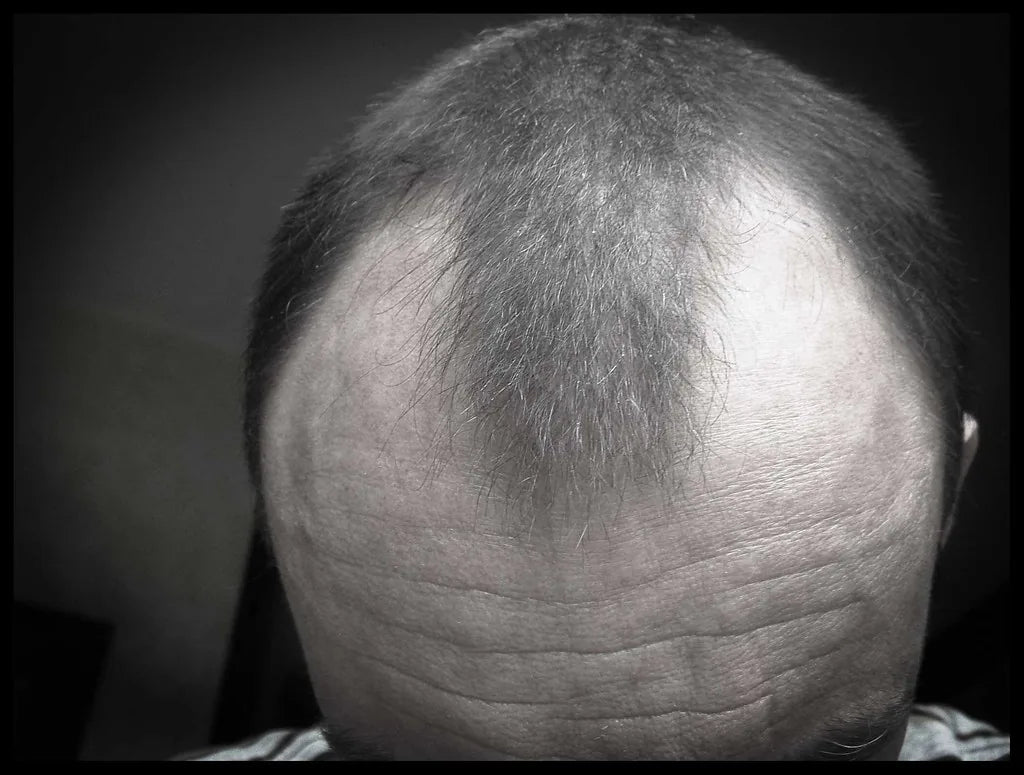
It is a less complete answer if you have noticed a receding hairline, a widening part, or visible thinning at the crown, the classic early markers on the Norwood or Ludwig scales that suggest androgenetic thinning is underway. In that case, cleansing can still be part of a good routine, but it is unlikely to be the part doing the meaningful work.
Who Regrowthy Makes Sense For
Regrowthy is built for someone who has already noticed real thinning and wants a routine that addresses more than the scalp surface. Because it combines a device, oral supplements, and topical treatments, it suits people who are comfortable with a daily or near-daily habit and want multiple mechanisms working at once rather than a single product doing double duty. It is also a fitting choice for someone who has looked into prescription options but prefers to start with, or stay with, a non-prescription approach that does not require a telehealth visit or an ongoing medical relationship to access.
If you are already using a scalp cleansing product like Nioxin and like the results, there is no real conflict in continuing it alongside a routine like Regrowthy's. Cleansing the scalp and treating the follicle are not competing strategies, they simply operate at different layers of the same problem. Many people end up doing both: a cleansing shampoo for scalp hygiene, and a more targeted routine for the biology of thinning underneath it.
For a sense of how this same "device plus supplement" approach compares to other well-known names, the comparison with another laser therapy brand covers similar ground from a different angle.
Ultimately, the honest answer to "nioxin vs regrowthy" is that they are not really solving the same problem, and that is useful information rather than a disappointing one. If your hair looks thin because your scalp needs a better cleansing routine, Nioxin is a well-established option built specifically for that. If your hair is thinning because of the biological processes that drive most pattern hair loss, a scalp cleansing system was never designed to be the whole answer, and a routine that pairs light therapy with targeted internal and topical support, like The Density Line and the Laser Therapy Cap, is aimed at that deeper problem directly. Knowing which situation you are actually in is the real first step, and it is worth being honest with yourself about which one describes what you are seeing in the mirror before you decide where to spend your money and your routine's daily minutes.
From the routine
Mentioned in this article
Common questions
Frequently asked questions
Does Nioxin actually regrow hair?+
Can I use Nioxin and Regrowthy products together?+
Why does Nioxin have different numbered systems?+
Is a scalp cleansing system enough on its own for hair thinning?+
What is the main difference between Nioxin and Regrowthy's approach?+
Does rosemary oil work the same way as Nioxin's peppermint oil ingredient?+
The Regrowthy System
Ready to start regrowing at home?
Hands-free. Non-prescription. 660nm clinical wavelength, backed by a 30-day guarantee.
Continue Reading
Product Comparisons
Nutrafol vs Regrowthy: Premium Hair Supplements Compared
9 min read
Product Comparisons
Capillus vs Regrowthy: FDA-Cleared Laser Caps Compared
8 min read
Product Comparisons
DS Laboratories Spectral vs Regrowthy: Topical Serums Compared
8 min read
Product Comparisons