Product Comparisons
Ro (Roman) vs Regrowthy: Telehealth Prescriptions vs a Non-Prescription System
Ro (Roman) puts a telehealth prescription for finasteride in your hands within days. Regrowthy takes the non-prescription route with a laser cap and a full supplement system. Here is how the two actually compare.
Updated July 1, 2026

Ro, often searched as Roman, is one of the better-known names in men's telehealth. Its hair loss line connects users with licensed providers who can prescribe finasteride and topical or oral minoxidil after a short online consultation, then ships the medication on a recurring basis. If you have been comparing Ro vs Regrowthy, you are really comparing two different philosophies for treating hair loss: one built around telehealth access to a prescription drug, the other built around a non-prescription system you can start the same day you order it.
A lot of people researching Roman hair loss treatment already know the basics of finasteride. It is one of the most studied medications in the category, and Ro has done real work making it easier to access than a dermatologist visit and a pharmacy trip. That convenience is genuine, and this article is not written to talk anyone out of a treatment that works for them. But telehealth finasteride is not the only path, and it is not the right path for everyone.
Regrowthy exists for the reader who wants a non prescription hair loss alternative: no consultation, no prescription on file, no systemic hormonal medication, just a laser cap and a supplement system you manage yourself. Below is an honest look at how the two compare, including where a telehealth prescription still makes sense and where it does not.
Ro vs Regrowthy at a Glance
Before getting into the mechanics of each approach, here is the shape of the decision in broad strokes.
- Ro (Roman): Telehealth consultation, prescription finasteride and/or minoxidil, ongoing provider oversight, recurring shipments, typically men-focused.
- Regrowthy: No consultation or prescription required, a 660nm Laser Therapy Cap plus The Density Line of supplements and topicals, available to men and women, ordered directly like any other consumer product.
- Shared ground: Both are subscription-based for ongoing use, both target androgenetic hair thinning, and both require consistency over months to see results.
- Core difference: One route runs through a physician-reviewed prescription that alters hormone metabolism. The other runs through light therapy and topical or ingested botanicals that do not require a prescription.
How Ro (Roman) Works
Ro's hair loss service is a telehealth funnel in the most literal sense. You fill out an intake questionnaire about your hair loss pattern, medical history, and current medications. A licensed provider in Ro's network reviews it, and if finasteride or minoxidil is deemed appropriate, a prescription is issued and the medication ships to your door on a recurring schedule. There is no in-person visit required, which is precisely the appeal for people who find scheduling a dermatology appointment inconvenient or who feel awkward discussing hair loss face to face.
The active ingredient behind most Ro hair loss review discussions is finasteride, an oral medication that works by inhibiting 5-alpha reductase, the enzyme responsible for converting testosterone into DHT (dihydrotestosterone). DHT is the hormone most closely tied to the follicle miniaturization that drives androgenetic alopecia in genetically predisposed men. By lowering systemic DHT levels, finasteride can slow or halt further thinning in a meaningful share of users, and some regrowth has been documented in long-term clinical trial data. This is well-established pharmacology, not a fringe claim, and it is the reason finasteride has remained a first-line prescription option for decades.
The trade-off is the part every telehealth finasteride review eventually has to address honestly. Because finasteride works systemically, a documented subset of users report sexual side effects, mood changes, or other symptoms, and the FDA has required label updates addressing the possibility that some of these effects persist after stopping the drug. Ro's telehealth model includes provider check-ins specifically because ongoing monitoring matters with a hormone-affecting prescription. That oversight is a genuine strength of the service. It is also a reminder that this is medicine, not a wellness product, and it comes with the same considerations you would weigh with any prescription: is the potential benefit worth the individual risk profile for you.
Key Point
Ro's core value is telehealth access to a real prescription medication with physician oversight. Regrowthy's core value is a non-prescription system you can start without a consultation. Neither claim cancels the other out. The right choice depends on whether you want pharmaceutical intervention with medical supervision, or a non-hormonal routine you manage on your own.
How Regrowthy Works
Regrowthy skips the prescription step entirely. There is no intake form reviewed by a provider and no medication shipped under a physician's name. Instead, the system is built around a device and a supplement line that work through different, non-pharmaceutical mechanisms. The Laser Therapy Cap uses 660nm LED light, a wavelength studied for photobiomodulation, to stimulate cytochrome c oxidase activity in follicle mitochondria. The theory, backed by a meaningful body of clinical research on low-level light therapy, is that this increases cellular energy output at the follicle and helps nudge dormant follicles back toward an active growth phase.
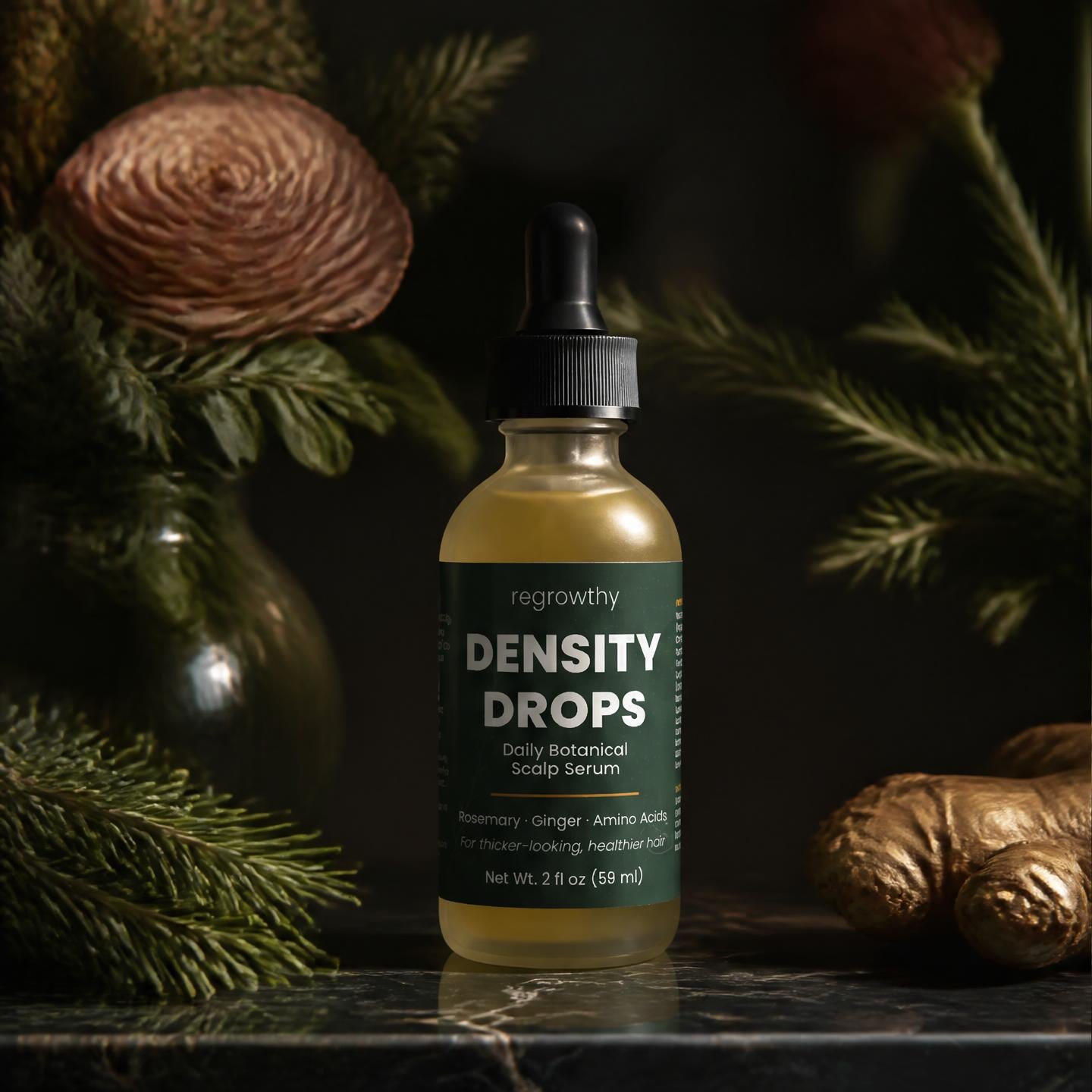
Alongside the laser cap sits The Density Line, Regrowthy's supplement and topical system. Daily Density Pro Capsules are built around botanical ingredients including saw palmetto, which functions as a mild, non-systemic 5-alpha reductase inhibitor rather than a pharmaceutical one. Dermatology literature on saw palmetto suggests it can modestly reduce local DHT activity without the systemic hormonal footprint of finasteride, which is exactly the trade a reader avoiding prescription medication is usually looking to make. Density Drops applies rosemary oil topically, an ingredient that clinical research has compared favorably to topical minoxidil in some trials, with a generally milder side effect profile.
The rest of the line rounds out the routine rather than trying to be a single silver bullet. Density Elixir and Daily Density Gummies support hair health nutritionally, Density Collagen Peptides support the structural protein environment around the follicle, and Dense Cleanse is a scalp shampoo designed to keep the follicle environment clean of the buildup that can interfere with topical absorption. None of these individually replace what a prescription drug does. Together, used consistently, they represent a different strategy: support the follicle from multiple non-hormonal angles instead of leaning on one systemic mechanism.
Telehealth Convenience vs an At-Home Routine
Part of what makes Ro appealing is the telehealth experience itself. No waiting room, no in-person exam, a provider reviewing your case on a schedule that fits your life. That is a real advantage for anyone who has been putting off treatment because the logistics of a dermatologist visit felt like too much friction. It is worth acknowledging plainly: telehealth has made prescription hair loss treatment more accessible than it was a decade ago, and that access has genuine value.
The trade-off is that a telehealth consultation, however convenient, is still a gateway to an ongoing prescription relationship. You need a provider's sign-off to start, you need to disclose your medical history, and you are committing to a medication that requires periodic reassessment. For some people that structure is reassuring. For others, especially those who have already researched finasteride's side effect profile and decided they would rather not take a systemic hormone-affecting drug indefinitely, the whole telehealth funnel is a barrier they would prefer to skip.
Regrowthy's at-home model removes that gateway. There is nothing to be prescribed, so there is no consultation to schedule and no ongoing medical oversight requirement, because there is no medication whose dosage or side effects need monitoring. That cuts both ways. The upside is you can start today, use it alongside other routines without drug interaction concerns, and stop whenever you want without a taper or a conversation with a provider. The downside is that a non-prescription system built on light therapy and botanicals is, by nature, working through gentler and generally slower mechanisms than a systemic pharmaceutical. If you want the most aggressive intervention available and you are comfortable with the associated risk profile, that is a legitimate reason to lean toward a prescription route like Ro's.
Who Should Choose Ro
If you have already decided that prescription finasteride is the treatment you want, and the main obstacle has been the hassle of getting a prescription, Ro's telehealth model solves exactly that problem. It is a legitimate, physician-backed way to access one of the most studied hair loss medications available, with ongoing provider check-ins built into the service. If you are comfortable with the potential for hormone-related side effects in exchange for the strongest available pharmaceutical intervention, and you would rather have a doctor managing that decision with you, Ro is a reasonable choice.
Who Should Choose Regrowthy
If you have read about finasteride's side effect profile and decided a systemic hormone-affecting medication is not something you want to commit to, Regrowthy is built for exactly that reader. If you want to start treatment today without a consultation, a prescription, or an ongoing medical file, the non-prescription route removes that friction entirely. And if you are a woman, the comparison tilts further in Regrowthy's direction. Finasteride is generally not prescribed to women of childbearing age, while the Regrowthy system, including the laser cap and The Density Line, is formulated for both men and women, including female pattern hair loss and postpartum shedding.
Regrowthy is also the more natural fit if you are looking for a complete routine rather than a single mechanism. Where Ro's hair loss offering is centered on one or two active pharmaceutical ingredients, Regrowthy layers a device, a topical, and internal supplementation, all working through different non-hormonal pathways at once. For readers who have compared other telehealth brands as well, the same logic shows up in our breakdowns of Hims vs Regrowthy and Keeps vs Regrowthy, since all three telehealth services share the same core finasteride-and-minoxidil model that Regrowthy is built as an alternative to.
The Bottom Line
Ro and Regrowthy are not really competing on the same axis. Ro is a telehealth company making a real prescription medication easier to access, with physician oversight built into the experience. Regrowthy is a non-prescription system built around a laser cap and a full supplement line, designed for people who want to address hair thinning without a hormone-affecting drug or a medical consultation standing between them and getting started.
Neither approach is a scam and neither is a miracle cure. Finasteride has a real, well-documented clinical record, and Ro has built a legitimate service around delivering it. Laser therapy and botanicals also have a growing body of clinical research behind them, and Regrowthy has built a full routine around that research rather than a single ingredient. The honest answer to which one is right for you comes down to how you weigh pharmaceutical efficacy against side effect risk, and whether you would rather manage your hair loss routine yourself or through an ongoing prescription relationship.
If you are still deciding, it helps to be specific about what you are actually trying to avoid or achieve. If the goal is the strongest available intervention and you are at peace with the side effect trade-off, a telehealth finasteride prescription through a service like Ro remains a well-supported option. If the goal is a non prescription hair loss alternative that you can start today, without a consultation and without touching your hormone levels, that is precisely the gap Regrowthy was built to fill.
From the routine
Mentioned in this article

Common questions
Frequently asked questions
Is Ro (Roman) legitimate for hair loss treatment?+
Can I use Regrowthy if I am currently taking finasteride from Ro?+
Does Regrowthy require a prescription like Ro does?+
Is Regrowthy a good option for women, unlike Ro?+
Which works faster, Ro's finasteride or Regrowthy's system?+
Does Ro offer anything like the Laser Therapy Cap?+
The Regrowthy System
Ready to start regrowing at home?
Hands-free. Non-prescription. 660nm clinical wavelength, backed by a 30-day guarantee.
Continue Reading
Product Comparisons
Hims vs Regrowthy: Two Very Different Approaches to Hair Loss
9 min read
Product Comparisons
Keeps vs Regrowthy: Prescription vs Non-Prescription Hair Loss Treatment
8 min read
Product Comparisons
Hers vs Regrowthy: Women's Telehealth Care vs a Non-Hormonal Routine
8 min read
Product Comparisons