Product Comparisons
Hers vs Regrowthy: Women's Telehealth Care vs a Non-Hormonal Routine
Hers offers prescription telehealth care for women's hair loss, while Regrowthy takes a non-hormonal, at-home approach with a laser cap and supplement routine. Here's how the two models actually compare.
Updated July 1, 2026

If you've been comparing hers vs Regrowthy, you're probably trying to answer one practical question: do you want a prescription-based telehealth service managing your hair loss, or a non-hormonal, at-home routine you control yourself? Both are legitimate paths. They just work in fundamentally different ways, and the right one depends on what kind of hair thinning you're dealing with and how you'd rather manage it.
Hers built its reputation on making women's healthcare more accessible, especially for conditions that used to require an in-person dermatology visit and an awkward conversation. For hair loss specifically, hers offers telehealth consultations that can lead to prescription treatments like topical minoxidil formulations, spironolactone, and other options a licensed provider determines are appropriate after reviewing your intake form. It's a real medical model: you answer questions online, a provider reviews your case, and if you're approved, prescription product ships to your door on a recurring basis.
Regrowthy takes a different route entirely. There's no prescription, no telehealth intake, and no hormonal medication involved. Instead, the approach combines a wearable red light device (the Laser Therapy Cap) with a supplement system built around scalp and follicle health. It's designed for women who want to address thinning through consistent daily habits rather than a prescription pad, or who've tried the telehealth route and want something that doesn't involve hormonal medication.
How Each Approach Works
Understanding the mechanism behind each option matters more than most people realize when they're first researching womens hair loss telehealth options. Hers operates on a medical model. You fill out a health questionnaire, sometimes including photos of your scalp and hairline, and a licensed provider reviews it remotely. If they determine a prescription treatment is appropriate, it gets shipped to you, and you typically have follow-up check-ins to monitor response and adjust dosing if needed. This is genuinely useful for women who have an underlying hormonal or medical component to their hair loss that needs to be addressed directly, such as androgenetic alopecia connected to hormone sensitivity.
Regrowthy's model doesn't route through a medical intake at all. Instead of a provider deciding what you need, you're choosing a self-directed routine built on a few well-understood mechanisms. Red light therapy at the 660nm wavelength has been studied for its effect on stimulating cellular activity in the hair follicle and extending the growth phase of the hair cycle. On the supplement side, ingredients like saw palmetto are included because of their traditional role in moderating DHT activity at the follicle, while other formulations in The Density Line focus on delivering biotin, collagen, and micronutrients that support the structural building blocks of hair strands.
Neither mechanism is a substitute for the other's strengths. A prescription can directly intervene in a hormonal pathway in a way a supplement generally cannot match in potency. But a non-hormonal hair loss treatment approach avoids the systemic hormonal side effects some women want to steer clear of, particularly those managing fertility plans, hormone-sensitive conditions, or simply a preference to avoid hormonal medication for hair.
Key Point
Hers requires a telehealth intake and, if approved, ships prescription treatment on a recurring basis. Regrowthy requires no medical intake at all: it's an at-home device and supplement routine you start and manage yourself, with no hormonal ingredients involved.
The Telehealth Model: What to Expect
If you're weighing a hers hair loss review against other options, it helps to know what the actual experience looks like. You start with an online questionnaire covering your medical history, family history of hair loss, current medications, and photos of your part line or hairline. That intake gets reviewed by a licensed clinician, and depending on your state and their assessment, you may be approved for a prescription topical or oral treatment. There's typically a subscription fee for the ongoing telehealth relationship on top of whatever treatment cost applies.
This model has real advantages. It gets you in front of a medical provider without needing to book a dermatology appointment, which can have long wait times in many areas. It's appropriate for women who suspect their hair loss might be tied to a hormonal imbalance, a thyroid issue, or another condition that benefits from a clinician's eyes on your case, since a provider can flag something that needs further workup rather than just treating the hair symptom in isolation.
The tradeoffs are worth naming too. Prescription treatments for hair loss can carry side effects, some women don't respond to the specific medication they're prescribed and have to cycle through options, and the ongoing dependency on a subscription means stopping the medication often means the benefit fades over time as well. There's also the reality that not everyone wants to route a scalp and hair concern through a prescription pathway, particularly women who've had less than ideal experiences with hormonal medications for other reasons in the past.
The Non-Hormonal, At-Home Model
Regrowthy's routine is built to be started the same day you decide to try it, with no waiting on a provider's approval. The laser cap is worn for a set number of minutes several times a week, delivering red light directly to the scalp. It's a passive, consistent habit more than an active treatment decision, which some women find easier to stick with than remembering to apply a topical solution twice a day.
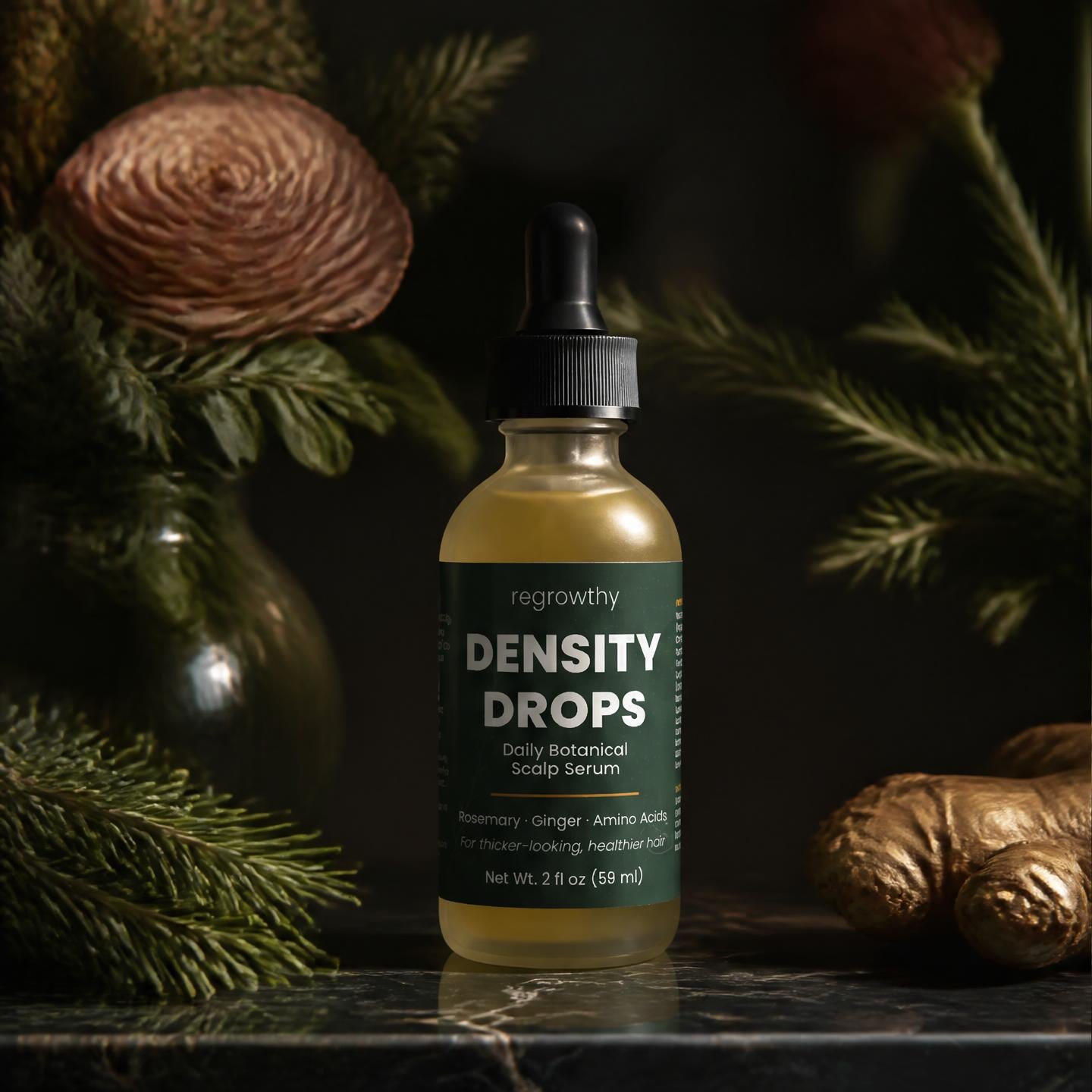
The supplement side is where the routine gets more nuanced, because it's not one product but a system. Daily Density Pro Capsules are the core daily supplement, formulated with ingredients aimed at supporting the hair growth cycle from the inside. For women who don't love swallowing capsules, Daily Density Gummies offer the same category of support in a different format. Density Drops and Density Elixir are liquid options that some people prefer for faster absorption or easier daily dosing. Density Collagen Peptides target the structural protein side of hair strength, since collagen naturally declines with age and affects strand thickness and elasticity. And Dense Cleanse, a scalp shampoo, addresses the scalp environment itself, since a buildup-prone or inflamed scalp isn't an ideal foundation for new growth regardless of what else you're doing.
None of these individually work like a prescription drug, and that's the point. They're designed to be layered together as a routine you can sustain for months or years without the ongoing medical oversight a prescription model requires. That said, "non-hormonal" doesn't mean "does nothing." Ingredients like rosemary oil and saw palmetto have a real, if more modest, body of research behind their role in scalp and follicle health, and consistency over months is what tends to determine whether a woman sees a meaningful difference.
Who Each Option Is Actually For
The honest answer to "hers vs Regrowthy, which is better" is that it depends on what's driving your hair loss and how you want to manage it. If you suspect a hormonal or medical cause and want a clinician actively involved in ruling things out and adjusting treatment, the telehealth model gives you that oversight. Hers can be a reasonable first stop if you've never had your hair loss evaluated and want a professional opinion without an in-person visit.
If you know your hair thinning is more likely tied to general aging, seasonal shedding, postpartum changes, stress, or a family pattern of thinning, and you'd rather not introduce a hormonal medication to address it, a non-hormonal routine may fit better. It's also a common choice for women who tried a prescription approach, didn't love the side effect profile or the ongoing dependency, and are looking for something they can control entirely on their own terms.
- Consider a telehealth route if you want a clinician to evaluate underlying causes, not just treat visible thinning.
- Consider a non-hormonal routine if you prefer to avoid systemic hormonal medication entirely.
- Consider combining approaches: some women use a prescription topical alongside a laser cap and supplement routine, since the mechanisms don't conflict.
- Consider your tolerance for ongoing subscriptions and check-ins versus a self-directed daily habit.
Cost and Commitment Considerations
Telehealth prescription models generally involve a recurring cost that combines a consultation or membership fee with the price of the medication itself, and that cost typically continues for as long as you want to keep the treatment's benefits, since discontinuing most hair loss prescriptions leads to a gradual return to your prior pattern of thinning. It's worth budgeting for that as an indefinite line item rather than a short-term expense.
Regrowthy's model is also ongoing, since the supplement subscriptions and the laser cap both require consistent use to matter, but there's no separate medical membership fee layered on top, and there's no prescription refill dependent on a provider's continued approval. The laser cap itself is a one-time device purchase, while The Density Line supplements are structured as a subscription to keep you stocked without having to reorder manually every month.
Neither path is inherently cheaper once you account for the full picture, so it's worth thinking less about sticker price and more about what kind of commitment fits your life: a recurring medical relationship with check-ins, or a self-managed daily and weekly routine.
Making the Decision
Start by being honest about what you actually know versus suspect about your hair loss. If you have signs pointing to a hormonal or thyroid issue, a genuine medical evaluation, whether through hers or an in-person dermatologist, is worth doing before or alongside anything else. Hair thinning can be a visible symptom of something else going on, and it's worth ruling that out.
If your hair loss looks more like a gradual, pattern-based thinning without other symptoms, and you'd rather not start with a prescription, building a consistent non-hormonal routine is a reasonable place to begin. The most important variable in either path isn't really which brand you pick, it's whether you'll actually stick with the routine for the several months it takes for any hair loss treatment, prescription or otherwise, to show a visible difference. Hair grows slowly, and both telehealth prescriptions and at-home routines require patience measured in months, not weeks.
Whichever direction you choose, treat the first three to six months as a genuine trial period rather than expecting an early verdict. Track your shedding, take consistent photos in the same lighting, and give the routine, medical or non-hormonal, a fair and complete run before deciding whether to adjust course.
From the routine
Mentioned in this article

Common questions
Frequently asked questions
Is hers a good option for women's hair loss?+
Can I use a non-hormonal routine alongside a hers prescription?+
How long does it take to see results from a non-hormonal hair loss treatment?+
Does Regrowthy require a prescription or medical consultation?+
What's the difference between Daily Density Pro Capsules and Daily Density Gummies?+
Is a non-hormonal hair loss treatment as effective as a prescription option?+
The Regrowthy System
Ready to start regrowing at home?
Hands-free. Non-prescription. 660nm clinical wavelength, backed by a 30-day guarantee.
Continue Reading
Product Comparisons
Keeps vs Regrowthy: Prescription vs Non-Prescription Hair Loss Treatment
8 min read
Product Comparisons
Nutrafol vs Regrowthy: Premium Hair Supplements Compared
9 min read
Product Comparisons
Hair Club vs Regrowthy: In-Person Franchise vs an At-Home Routine
9 min read
Product Comparisons